
Securing a Room in Korea From Abroad: An Exchange Student's Timeline
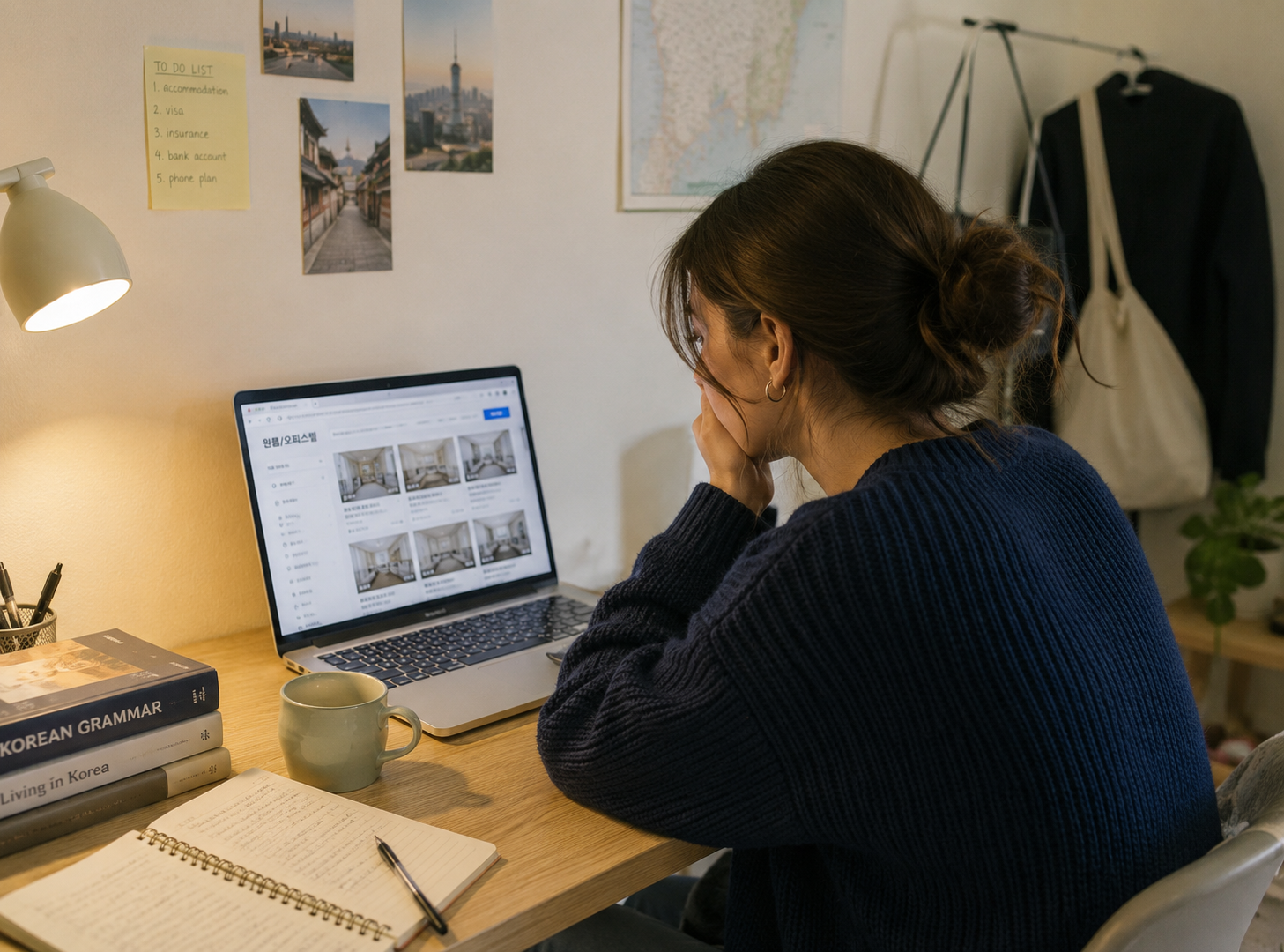
Between your dorm rejection and your flight, you have somewhere between six weeks and three months to secure housing in a country you've never been to, in a language you may not read, without seeing the room.
It's a compressed timeline and a genuinely uncomfortable one. But exchange students do it successfully every semester, and the ones who do it well are following roughly the same sequence. This guide is that sequence.
→ One Semester in Korea: Housing for Exchange Students Who Didn't Get the Dorm
The Timeline
Working backwards from a September semester start — the larger intake, and the one most exchange students arrive for. For a March start, shift every date back six months.
⏰ If you're reading this in July: you're at roughly the 6–8 week mark. That's tight but workable — skip ahead to "Start contacting" and compress the first two stages into this week.
10–12 weeks out (June) — Decide the type
Before you look at a single listing, decide what kind of housing you're looking for. Goshiwon, share house, and short-term one-room have completely different search channels, price points, and contract processes — searching all three at once wastes the time you don't have.
Set your budget as a total, not a monthly figure: monthly rent × 4.5 months + deposit + first-month costs.
Deliverable this stage: housing type chosen, total budget number written down.
8–10 weeks out (late June–early July) — Narrow the area
Pick two or three neighbourhoods near your campus and learn their price ranges. This matters more than it sounds: knowing that a one-room near your university runs ₩500,000–₩600,000 is what tells you a ₩350,000 listing is either a goshiwon, a mistake, or a scam.
Use Naver Map rather than Google Maps for Korean addresses and transit times — it's substantially more accurate.
→ How to Use Naver Map When Searching for an Apartment in Korea → Cheapest Areas to Rent in Seoul for Foreign Students & Expats
Deliverable this stage: 2–3 target neighbourhoods, known price range for each.
6–8 weeks out (July) — Start contacting
This is when you begin actual conversations with operators, agents, or platforms. Expect this stage to take longer than you think: replies come back on Korean business hours, and there's usually a translation delay in both directions.
Ask for a live video walkthrough — a real-time video call where someone walks through the actual room, opens the bathroom door, shows the window view. Not a pre-recorded tour, not a photo set. A live walkthrough is the closest thing to a viewing you can get from abroad, and an unwillingness to do one is informative.
Deliverable this stage: 3–5 real options with live walkthroughs completed.
4–6 weeks out (late July–August) — Verify, then reserve
Before any money moves, verify. This is the stage people skip when they're anxious about running out of time, and it's the stage that matters most. (Detail in the next section.)
Once you're satisfied, reserve the room — typically around 10% of the deposit, which counts toward it — and confirm in writing that the move-in date matches your arrival, including what happens if your flight is delayed.
Reserve only when you've decided. A reservation payment in Korea is a contractual commitment, not a refundable hold: if you back out, you generally don't get it back.
Note that reserving is not the same as signing the lease. The actual contract is normally signed in person, on or just before move-in day.
Deliverable this stage: room reserved, terms confirmed in writing, move-in date locked.
1–2 weeks out — Arrival and signing logistics
Confirm key handover: who meets you, where, at what time, and what happens if you land at 11pm. Ask whether you can leave luggage before the official move-in time if your flight arrives early.
Also confirm the contract signing appointment — since the lease is normally signed on or just before move-in day, you need to know when and where it happens, who will be there, and what to bring (passport, and your ARC if you already have one).
How this gets arranged matters more than it sounds. Coordinating a signing date directly with a Korean landlord or agent, from abroad, in Korean, is where a lot of arrivals get stuck — messages go unanswered, dates shift, and you land without knowing when you're actually signing. If you booked through a platform that handles scheduling and sends you the contract details in advance, this stage is simply a confirmation rather than a negotiation.
Have a backup for your first night. A confirmed room does not always mean a confirmed key at the hour you land.
Verifying a Listing You Can't Visit
This is the part that actually protects you. Fake listings targeting arriving foreigners are among the most common rental scams in Korea, and exchange students are a preferred target — booking remotely, under time pressure, unable to check anything in person.
The key thing to understand is that securing a room from abroad happens in two stages, and different checks belong to each.
Stage 1 — Reserving the room from abroad
At this point you are holding the room, not signing a lease. You'll typically pay a provisional contract fee of around 10% of the deposit to take it off the market until you arrive.
What you can realistically verify at this stage:
- The property exists as described
- Get the full address and check it on Naver Map street view
- Confirm the building in the photos matches the building at that address
- Ask for a live video walkthrough — a real-time call where someone walks the actual room. Not a photo set, not a pre-recorded tour. Reluctance to do one tells you something.
- The room matches what you're being told
- Floor, direction the windows face, exact size
- What furniture and appliances are actually included
- Building age and whether there's an elevator
- Monthly maintenance fee (관리비) and what it covers
- The terms are written down before you pay
- Move-in date, monthly rent, deposit, contract length
- What the reservation amount is and what it counts toward — normally it goes toward your deposit
- What happens if you change your mind: understand this before you pay, not after
⚠️ A provisional contract fee is not a refundable holding fee. In Korea, putting money down to hold a room creates a contractual commitment (가계약금). If you back out — you found somewhere better, your plans changed, you decided against the room — that money is generally not returned. The landlord took the room off the market on the strength of your commitment.This cuts both ways, and it's why the reservation is worth something: it means the room is genuinely held for you. But only reserve a room you have actually decided on. Do not reserve two rooms to "keep options open" — you will lose one of those payments.
⚠️ The single biggest red flag when booking remotely: being asked to transfer money to an individual's personal bank account, based on photos, before anything is confirmed in writing. This is how most remote rental scams work. If you're paying, you should know exactly what the payment is for and what it counts toward.
Stage 2 — Signing the actual contract after you arrive
The real lease is normally signed in person, on or just before your move-in day. This is when the heavier verification happens — and when it can happen properly, because you're standing in the building.
- Check the property register (등기부등본). This shows who legally owns the property and whether there are existing loans or claims against it. It matters because your deposit's safety depends on it — if the building is heavily mortgaged, your deposit sits behind the bank in priority. This is a contract-signing check, not something to demand from a stranger while you're still abroad.
- Confirm the person signing is the owner — the name on the contract should match the name on the property register. If someone is signing on the owner's behalf, they need documented authority.
- If an agent is involved, they should have a licence (중개등록번호) you can verify.
- See the actual room before you sign. The room you reserved should be the room you're standing in. Check it against what you were shown remotely.
- Read the contract, translated. Not summarized — translated. Especially the 특약사항 (special agreements) section, where anything you negotiated should appear in writing.
→ Korean Rental Contract Explained: 13 Clauses Every Foreign Renter Must Understand → How to Read a Korean Property Register (등기부등본)
💡 Splitting it this way is what makes remote booking manageable. You're not signing a year-long legal commitment from your bedroom in another country — you're holding a room, then doing the serious checks in person when you can actually do them properly.
What Usually Goes Wrong
- Starting after the dorm result. The single most common mistake. Dorm rejections arrive close to the semester start, precisely when the market is busiest. Begin researching before you know the answer — a backup you've already scoped costs nothing.
- Underestimating reply times. Korean business hours plus translation means a simple back-and-forth can take two days. Build that in.
- Assuming the deposit is small. Students budget for rent and are then surprised by a ₩5,000,000 deposit request. Know this number before you fall in love with a listing.
- No plan for the first night. Flights land late, key handovers happen during business hours, and move-in dates don't always align with arrival dates. Book something for night one.
- Paying before verifying. Covered above, and worth repeating: this is the one that costs real money.
What You Genuinely Cannot Judge Remotely
Even a good video walkthrough has limits. These are the things that only a physical visit reveals, and it's worth knowing what you're accepting:
- Noise — traffic, neighbours, thin walls, the bar downstairs
- Damp and mould — a camera doesn't show it, and it's a real problem in Korean buildings
- Water pressure and hot water
- Actual light — a north-facing room photographs brighter than it lives
- Insulation — the single biggest complaint about older Korean rooms in winter
- The walk — the map says twelve minutes; the map does not say it's uphill
The practical response is to weight your decision toward things you can verify (ownership, contract terms, building age, exact location) and to prefer shorter commitments where you can't. A four-month lease in a room that turns out to be noisy is survivable. A twelve-month one is not.
→ What to Check When Viewing an Apartment in Korea: A Room Inspection Guide for Foreign Renters
If You Can't Secure Anything Before You Fly
Sometimes it doesn't come together. That's recoverable, but plan it deliberately rather than landing and hoping.
Book two to three weeks of temporary accommodation — a guesthouse, a short-stay goshiwon, a hostel — and search in person once you arrive. Viewing rooms yourself is genuinely better than remote searching, and two weeks is usually enough.
The cost of temporary housing is real but bounded. The cost of a rushed remote decision on a bad room, or a scam, is not.
Searching from another country, in another language, on a deadline is a lot to manage alone. Checkmate Korea lets you reserve a room before you fly — you request a booking, the landlord approves it, and the reservation amount goes toward your deposit. Scheduling the contract signing and receiving the details you need beforehand happen through the site, so you're not chasing a landlord or agent in Korean from another time zone. The lease itself is signed after you land, with support in English.
Reserve a Room Before You Land →