
How to Read a Korean Property Register (등기부등본)
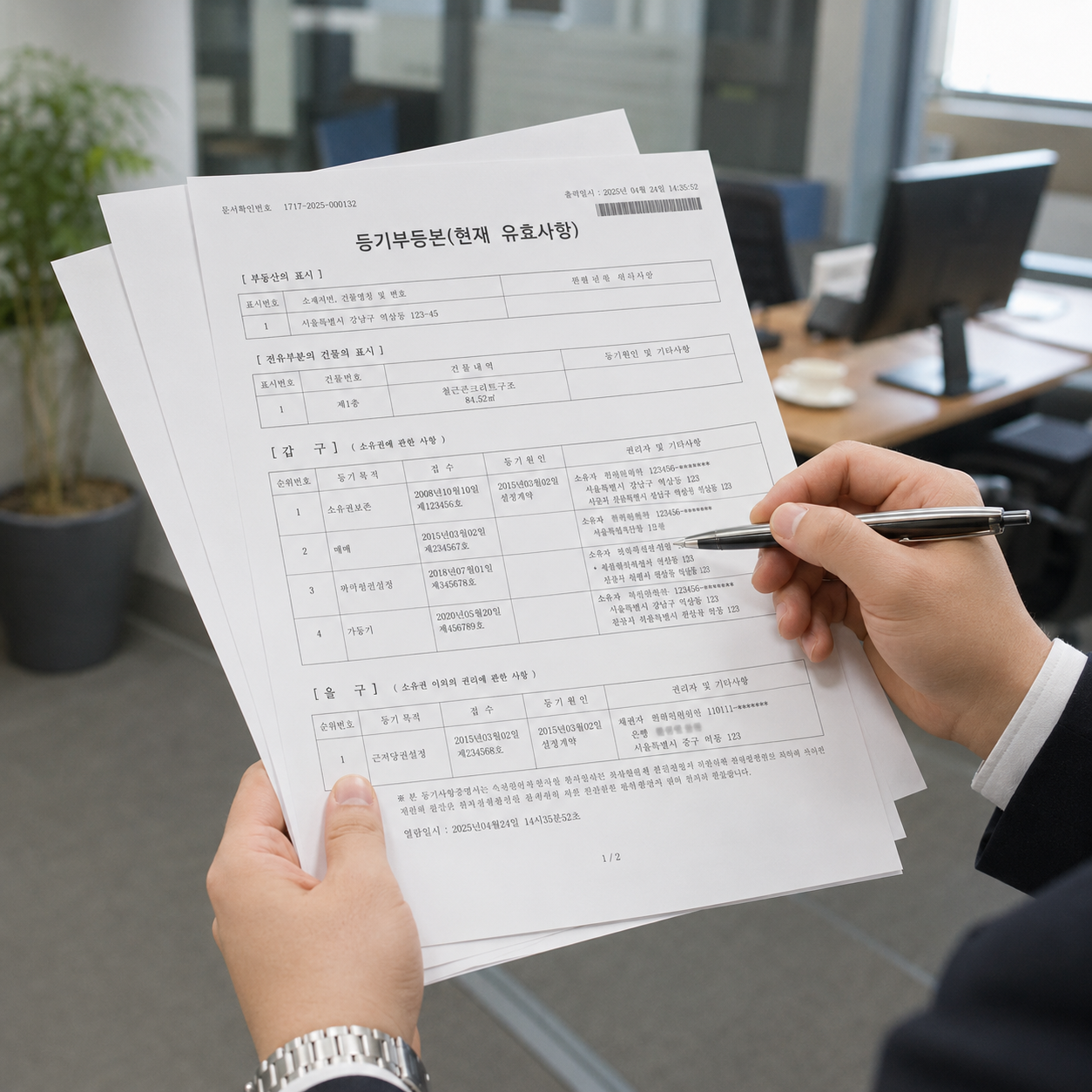
Before you hand over a deposit in Korea — often several million won, sometimes tens of millions — there is one document that tells you whether that money is safe. It's the property register (등기부등본), and checking it is the single most important thing you can do before signing a lease.
It tells you two things that matter enormously: who actually owns the property (so you know you're dealing with the real owner), and how much debt is secured against it (so you know where your deposit stands if things go wrong). Anyone can pull one, for anyone's property, in a few minutes, for about ₩700 — without the owner's permission and without giving a reason.
This guide explains how to get one and how to read the parts that matter to a tenant.
Why This Matters More for a Deposit Than You'd Think
Korea's deposit system means you're handing a large sum to a private individual and trusting you'll get it back at the end. The property register is what lets you check whether that trust is well-placed.
The core risk is called 깡통전세 — a "hollow" lease, where the property carries so much existing debt that if it's auctioned, the proceeds go to the bank first and there's nothing left for your deposit. The register is where you see that debt before you're exposed to it.
For a foreign tenant this is doubly important, because you may be less able to read warning signs a Korean tenant would catch, and less able to chase a lost deposit from abroad. Five minutes with the register removes most of that risk.
How to Get One
Online (the standard way)
The fastest method is the Supreme Court's Internet Registry Office (대법원 인터넷등기소, www.iros.go.kr). It's available 24 hours, and you don't need to be a member to use it.
- Viewing (열람): ₩700 — you can read it on screen and save a PDF
- Issuing (발급): ₩1,000 — an official certified copy with legal validity
For simply checking a property before signing, viewing (열람) is enough. You only need the address (소재지번) or the property's unique registration number. No seal, no power of attorney, no consent from the owner.
There's also an Internet Registry Office app for phones, though for the detailed options below, a computer is easier.
Options worth selecting
When you pull the register, a few settings matter:
- 말소사항 포함 (include cancelled entries): shows debts and claims that were once registered and later cleared. Useful for seeing the property's history.
- 현행 vs 현행+전산폐쇄: "current" versus "current plus closed records." For checking ownership history and past debt, current-plus-closed is safer.
- 공동담보/전세목록: worth including if you want to see shared collateral arrangements.
For a normal pre-lease check, the current register with cancelled entries included tells you what you need.
In person
You can also use an unmanned issuing machine (무인발급기) or visit a registry office (등기소). Government portals like 정부24 ultimately route to the same Internet Registry Office, so online is usually simplest.
The Three Sections
A Korean property register has three parts: 표제부, 갑구, and 을구. You read them in order, and each answers a different question.
표제부 (Description) — Is this the right property?
The 표제부 describes the property physically: address (소재지번), building name and number, area, floors, and structure.
What to check: that the address here exactly matches the property you're about to rent. This sounds trivial and isn't — in multi-unit buildings, confirming you're looking at the register for the correct unit (dong and ho) is essential.
💡 If the area or structure on the register doesn't match what you're seeing in person, that can be a sign of unpermitted construction (무허가 증축) — relevant especially for rooftop rooms. Worth asking about.
갑구 (Section A) — Who owns it?
The 갑구 records everything about ownership: who owns the property now, how ownership has changed hands, and any restrictions on it — 가압류 (provisional seizure), 압류 (seizure), 가처분 (provisional disposition), or 경매개시결정 (start of auction proceedings).
What to check:
- The current owner's name matches the person you're signing with. This is the anti-fraud check. If the landlord's name and the registered owner's name don't match, stop and find out why. Compare the name and resident registration details against the landlord's ID.
- No seizures or auction proceedings. 가압류, 압류, or 경매개시결정 in the 갑구 are serious warning signs — the property is already in dispute or heading for auction.
- Ownership hasn't changed suspiciously often. Frequent recent changes of owner can indicate a problem property.
⚠️ If someone other than the registered owner is signing — an agent, a family member, a "representative" — they need documented authority (a power of attorney and the owner's certified seal). A signature from someone who isn't the owner and can't prove authority is a common fraud pattern.
을구 (Section B) — How much debt is on it?
The 을구 records rights over the property other than ownership — most importantly 근저당권 (mortgage/security interest) and 전세권. This is where you find out how much the property is borrowed against.
What to check:
- 근저당권 (mortgage). If this appears, the owner has borrowed money against the property. The figure shown is the 채권최고액 — the maximum secured claim, typically set at 110–130% of the actual loan.
- The priority order. A mortgage registered before your lease ranks ahead of your deposit. If the property is auctioned, that lender is paid first.
- An empty 을구 means no debt is secured against the property — the safest situation.
The Calculation That Actually Protects You
Here is the check that matters most, and it's arithmetic you can do yourself.
Add the total secured debt (채권최고액) to your deposit. Compare that sum to the property's market value.
If (existing debt + your deposit) exceeds roughly 70–80% of the property's value, your deposit is at meaningful risk. In an auction, the property may not sell for enough to cover both the bank and you — and the bank is first in line.
A rough worked example:
- Property market value: ₩200,000,000
- Existing mortgage (채권최고액) in 을구: ₩120,000,000
- Your proposed deposit: ₩50,000,000
- Total claim ahead of and including you: ₩170,000,000
- That's 85% of value — a danger zone. If the property sells at auction for less than its nominal value (they usually do), your ₩50,000,000 may not be fully recoverable.
The safest situation is an empty or near-empty 을구, where your deposit is the primary claim on the property. The more prior debt there is, the smaller the deposit you should be willing to put down — or the more reason to walk away.
→ Deposit vs. Monthly Rent in Korea: How to Negotiate Wolse and Protect Your Money
When to Pull the Register — and How Often
Before you sign. Obviously. This is the check that informs whether to proceed at all.
Again on the day you sign. This is the one people miss. A register can change between your first viewing and the signing date — a landlord can take out a new mortgage in the interim. Pull a fresh copy on the actual signing day and confirm nothing has changed, especially the 을구.
Again the day after your address registration takes effect, if you want to be thorough — to confirm no new claim was registered in the gap while your own protection was taking effect.
⚠️ The signing-day check is not paranoia. The window between agreement and move-in is exactly when a distressed owner might borrow further against the property, and a mortgage registered before your protection takes effect outranks you.
What the Register Can't Tell You
It's a powerful document but not a complete one. It does not show:
- Unpaid Taxes (미납 국세·지방세): Overdue national or local taxes can take priority over your deposit in an auction, and they do not appear on the property register. Under current Korean law, if your deposit exceeds ₩10,000,000, you have the legal right to inspect the landlord's tax arrears at the local tax office after signing your lease, even without the landlord's explicit consent.
- Other tenants' deposits in a multi-unit building, which also rank against the property.
- The true market value. You need that from listings, recent transactions, or an agent to run the calculation above.
For these reasons the register is necessary but not always sufficient. It's the first and most important check, not the only one.
Quick Checklist
Reading a property register in Korean, and judging whether the debt on it puts your deposit at risk, is exactly the kind of check that's hard to do confidently alone in a new country. CheckmateKorea helps foreign tenants verify a property before they commit — and explains what the register actually says.
- Renting in Korea Without Korean: Why Most Foreigners Shouldn't Do It Alone →
- Deposit vs. Monthly Rent in Korea: How to Negotiate Wolse and Protect Your Money →
- Rental Scams in Korea: 5 Types Foreigners Fall For (And How to Avoid Them) →
- Banjiha and Oktapbang: What to Check Before You Sign →
- Korean Rental Contract Explained: 13 Clauses Every Foreign Renter Must Understand →