
Korean Rental Contract Explained: 13 Clauses Every Foreign Renter Must Understand
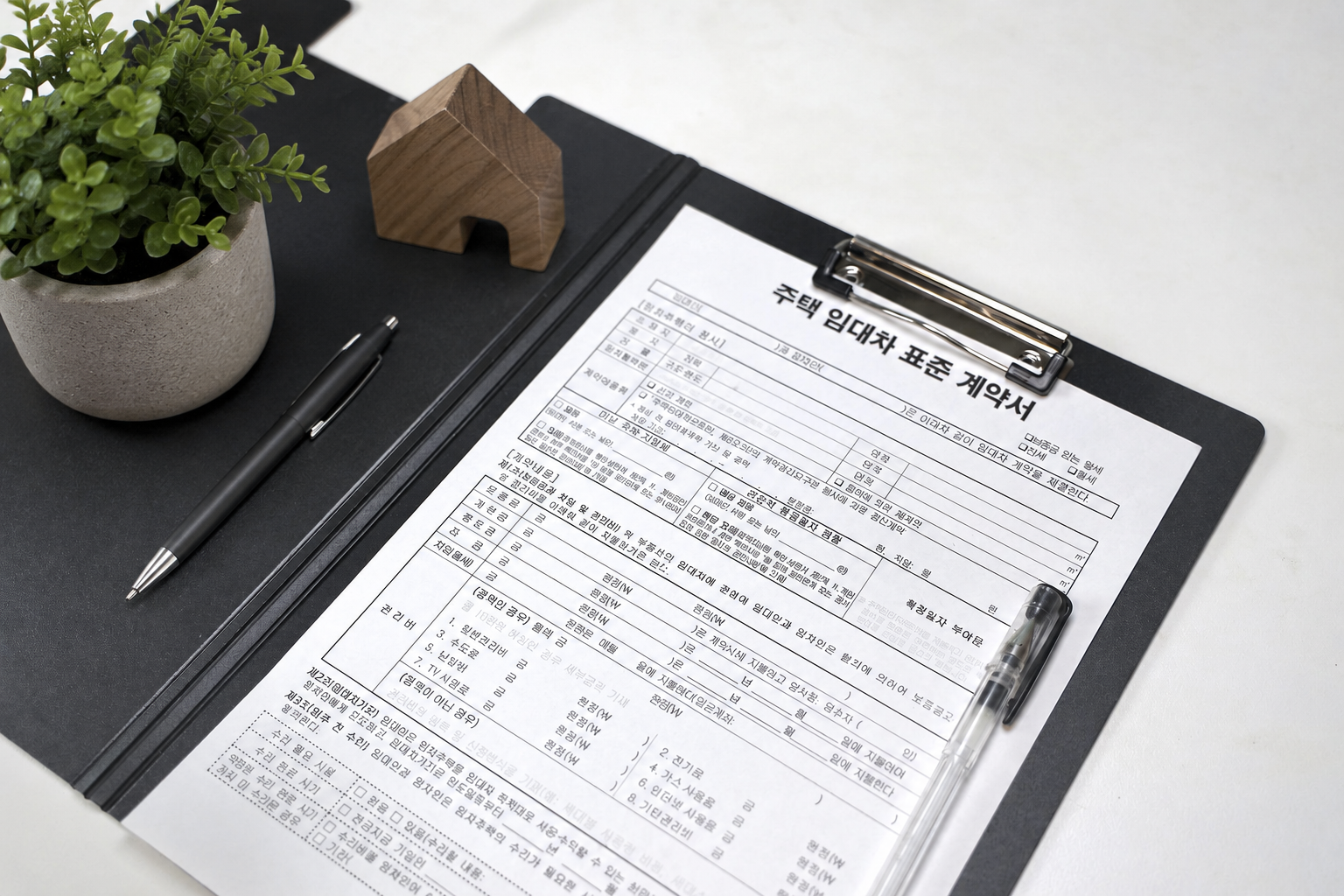
Most Korean real estate agencies do not provide English contracts. What you'll receive is a standard Korean lease form (주택임대차표준계약서) — several pages of Korean text covering everything from your deposit amount to what happens if the shower breaks.
This guide explains each section, so you know exactly what you're signing.
💡 If you use Checkmate Korea's service, an English translation and clause-by-clause explanation is provided as part of the contract process. The guide below is based on the standard Korean lease form.
What Is the standard Korean lease form(주택임대차표준계약서)?
The 주택임대차표준계약서 is the government-standard residential lease agreement used across Korea. .
The standard form covers 13 key items across four sections. Here's what each one means.
**Since most Korean real estate agencies do not provide English contracts, the following explanations are based on Korean contracts. Translation is provided if you use Checkmate service.
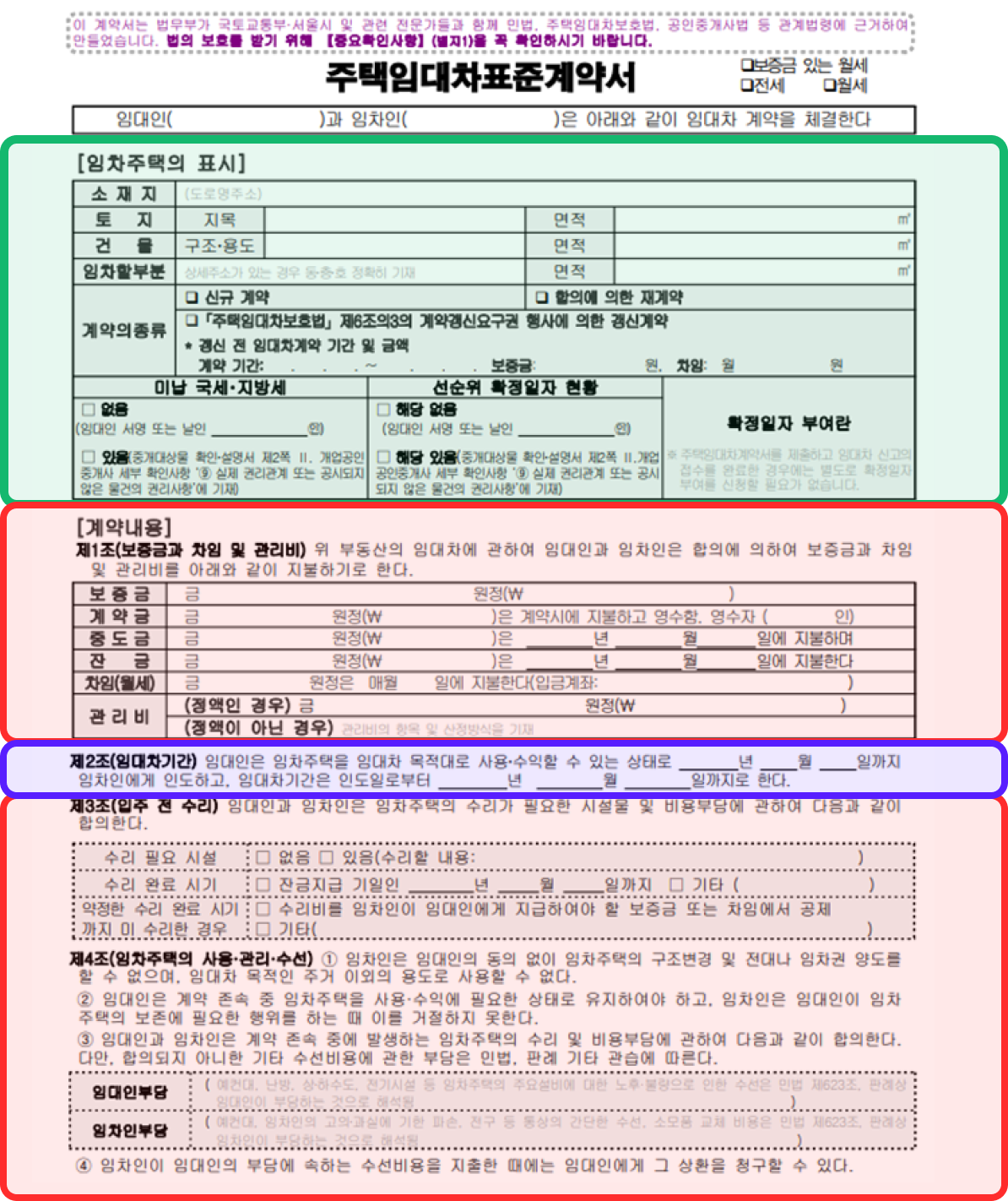
- Information of rental house : Basic information about the rented house.
- Deposit, monthly rent, maintenance fee : When and how much money to pay the landlord.
- Lease term : How long you are going to borrow the house and the exact date
- Repair : How to take responsibility for repair
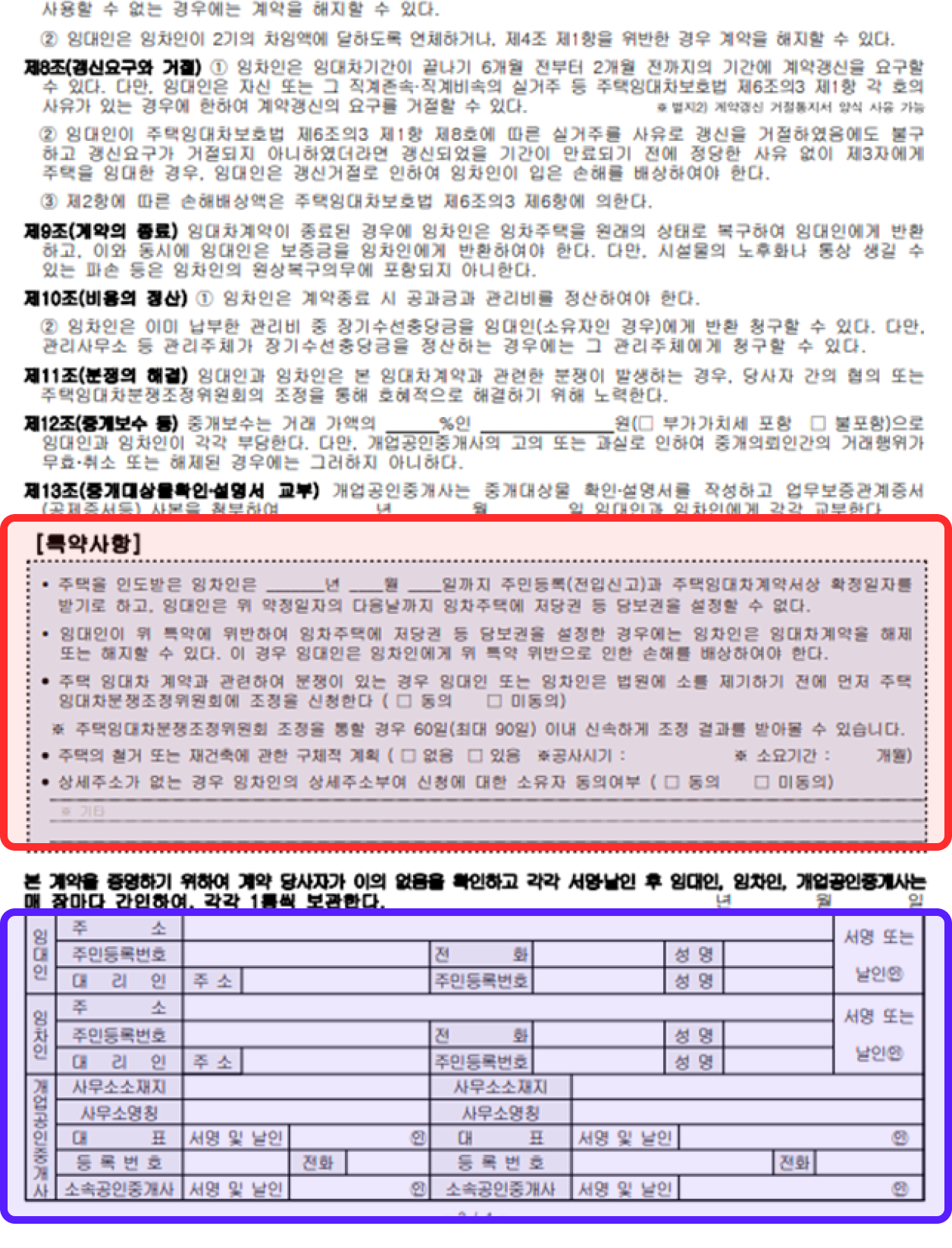
- Special agreements : Additional pledge the landlord and tenant have made
- Landlord, tenant, real estate agent : Information about who you signed with
*Since not everyone fully understands the real estate laws, we need someone to help us with the contract. A licensed real estate agent helps the contract between the landlord and the tenant.
Section 1: Information About the Rental Property (임차주택의 표시)
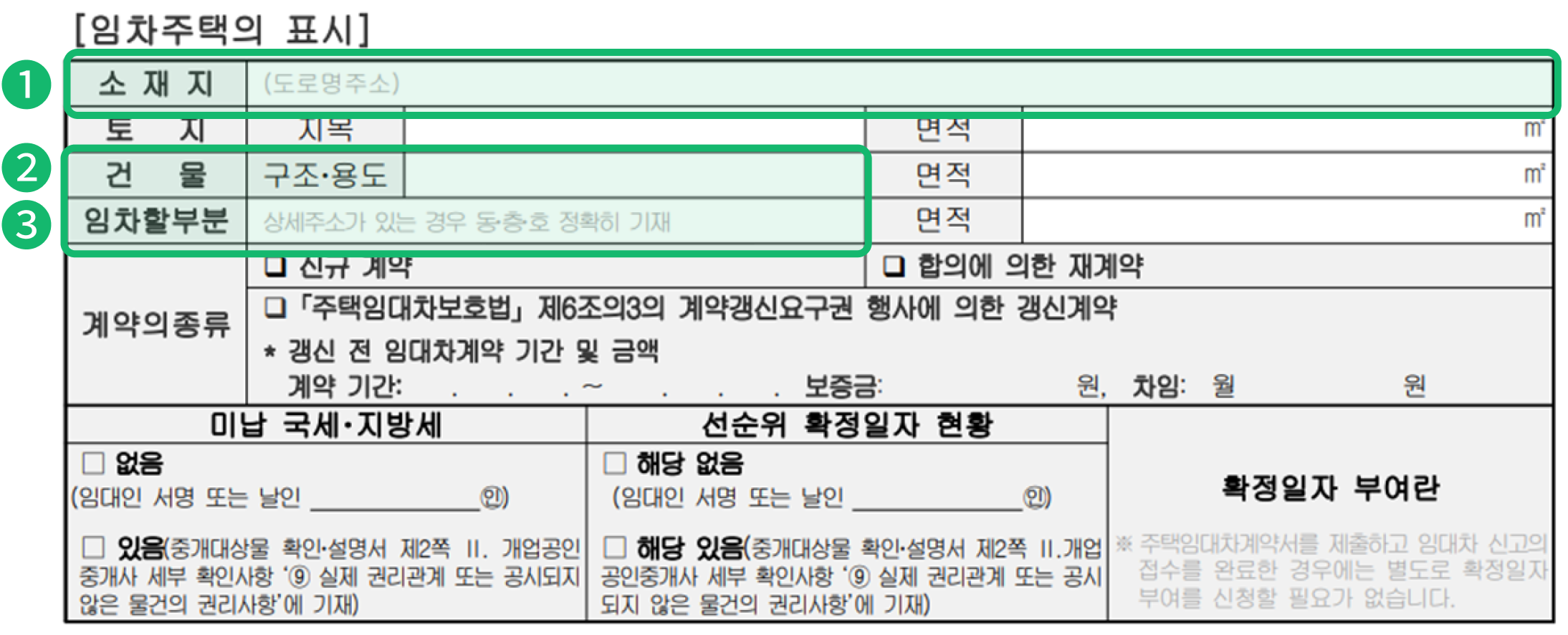
① Address (소재지)
The full address of the unit you're renting. Check that this matches the address in the property registry (등기부등본) and the actual unit you viewed. Even small discrepancies — a wrong floor or unit number — can cause legal problems later.
② Usage (용도)
The building's actual, physical use — not just its registered category — is what determines coverage under the Housing Lease Protection Act (주택임대차보호법). Korean courts have consistently ruled that this depends on actual use at the time of the contract, not on how the building is listed in the registry (등기부등본/건축물대장). So even if a unit is registered as commercial or business-use, it can still be protected if it's genuinely set up and used as a home. That said, this creates a practical burden, not a legal gap: with officetel units especially, if the registered use differs from actual use, you may need to actively prove residential use later (move-in registration, actual occupancy, contract wording) if a dispute ever comes up — for example in a foreclosure or auction. To reduce that risk, make sure the contract itself states the purpose as residential (주거용) and that the unit was already fitted out as a home (kitchen, bathroom, etc.) when you signed.
③ Property to Rent (임차할 부분)
The specific room or unit within the building. If you're not renting the entire building, the building number, floor, and unit number must all be written clearly. A vague description like "one room on the 3rd floor" isn't sufficient.
Section 2: The Money (계약내용 — 제1조)
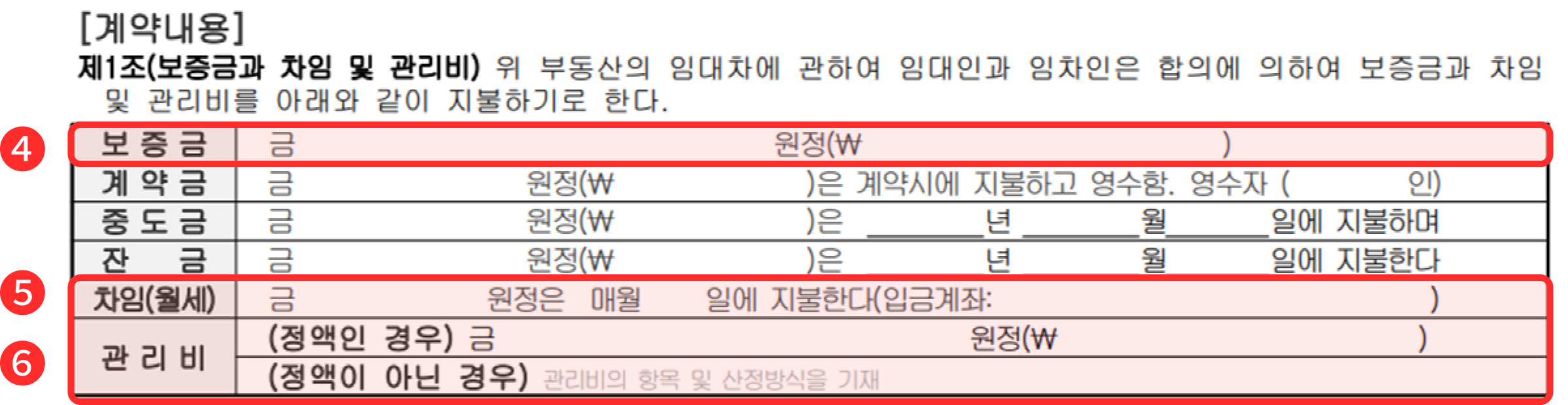
④ Deposit (보증금)
The total security deposit amount. This is the large sum you hand over at the start of your lease and get back at the end — assuming no legitimate deductions. Double-check this number against what was verbally agreed.
⑤ Monthly Rent (차임/월세)
The monthly payment amount and the date it's due each month (e.g., "paid on the 1st of each month to the landlord's account"). Confirm the payment account number is written in the contract and matches the property owner's information.
⑥ Maintenance Fee (관리비)
Money paid on top of rent for shared building services — typically covering elevator maintenance, corridor lighting, and shared cleaning. The contract should specify either a fixed amount (정액인 경우) or the items and calculation method (정액이 아닌 경우). Ask what's included before signing — some buildings include water and heating in the management fee, others don't. This can add ₩50,000–₩200,000 to your effective monthly cost.
How the Deposit Is Paid — Three Stages
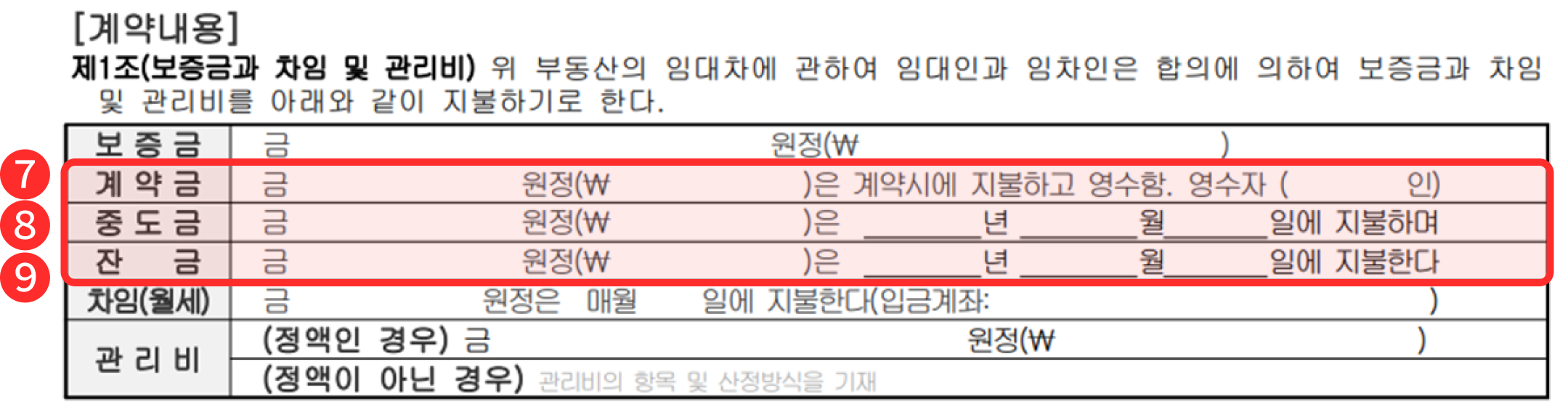
Korean deposits aren't always paid in one lump sum. They're typically split into three stages:
⑦ Down Payment (계약금)
The money meaning ‘You and I have agreed to this contract. Paid at the moment or in advance of signing — usually around 10% of the total deposit. This payment signals that both sides are committed. Once paid, neither party can easily back out: if the landlord cancels, they must return double the down payment. If you cancel, you forfeit the down payment entirely.
⑧ Intermediate Payment (중도금)
A middle payment between the down payment and the final balance. This step is often skipped for smaller deposits — many studio rental contracts go straight from down payment to balance.
⑨ Balance (잔금)
The remaining deposit amount, paid on or before move-in day. After this payment, you take possession of the keys. Verify the balance payment account one more time on the day of transfer — confirm it matches the owner's name on the property registry before sending.
Section 3: Lease Term (제2조 — 임대차기간)

⑩ Lease Term (임대차기간)
The start and end dates of your tenancy. Under Korean law, even if your contract says less than 2 years, you have the right to stay for 2 years (the minimum protected period under the Housing Lease Protection Act). However, if you want to leave before the contract end date, early termination requires at least 2 months' written notice to the landlord — and the landlord's cooperation in finding a new tenant.
⚠️ For foreign students on 10-week language programs, this is one of the most common points of friction. If your intended stay is less than a year, clarify the early termination terms explicitly in the contract before signing, or look for a landlord who accepts shorter leases.
Section 4: Repair Responsibilities (제3조 & 제4조)
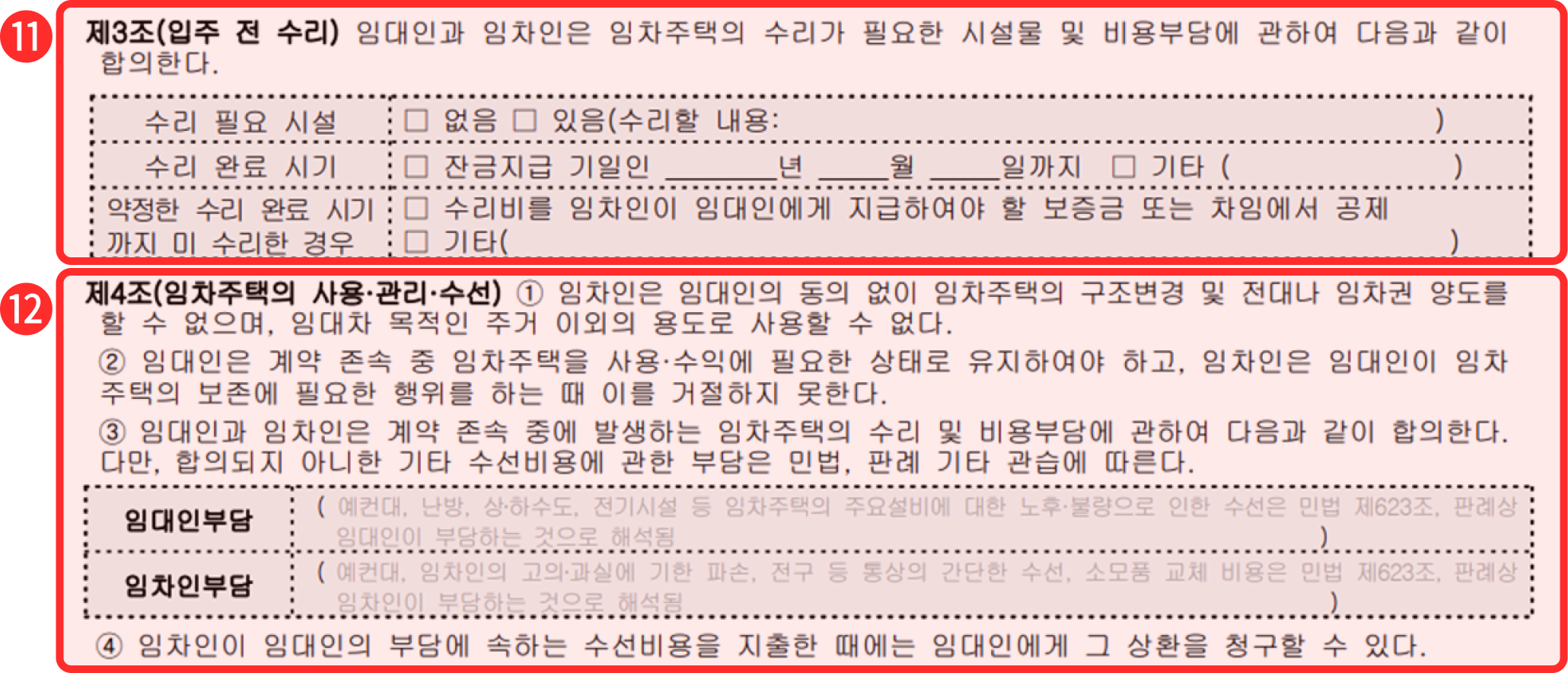
⑪ Pre-Move-In Repairs (제3조 — 입주 전 수리)
If there are items that need to be repaired before you move in — a broken shower, a damaged wall, a malfunctioning boiler — this clause is where the landlord commits to fixing them by a specific date. If you noticed any defects during your viewing, get them listed here, with a completion deadline. A verbal promise to "fix it later" is not enforceable.
⑫ Ongoing Repair Responsibilities (제4조 — 사용·관리·수선)
This clause defines who is responsible for repairs during the tenancy:
- Landlord's responsibility (임대인부담): Major structural repairs, essential systems (heating, plumbing, electrical wiring), items that wear out through normal use
- Tenant's responsibility (임차인부담): Minor repairs caused by the tenant's own use — a broken light bulb, a cracked tile you caused, small everyday wear
⚠️ Why this matters: If the shower breaks two months in and you didn't document its condition at move-in, the landlord can claim you broke it. Photograph every room thoroughly before moving your things in, and note any existing defects in writing — signed by both parties if possible.
Section 5: Special Agreements (제12조 — 특약사항)
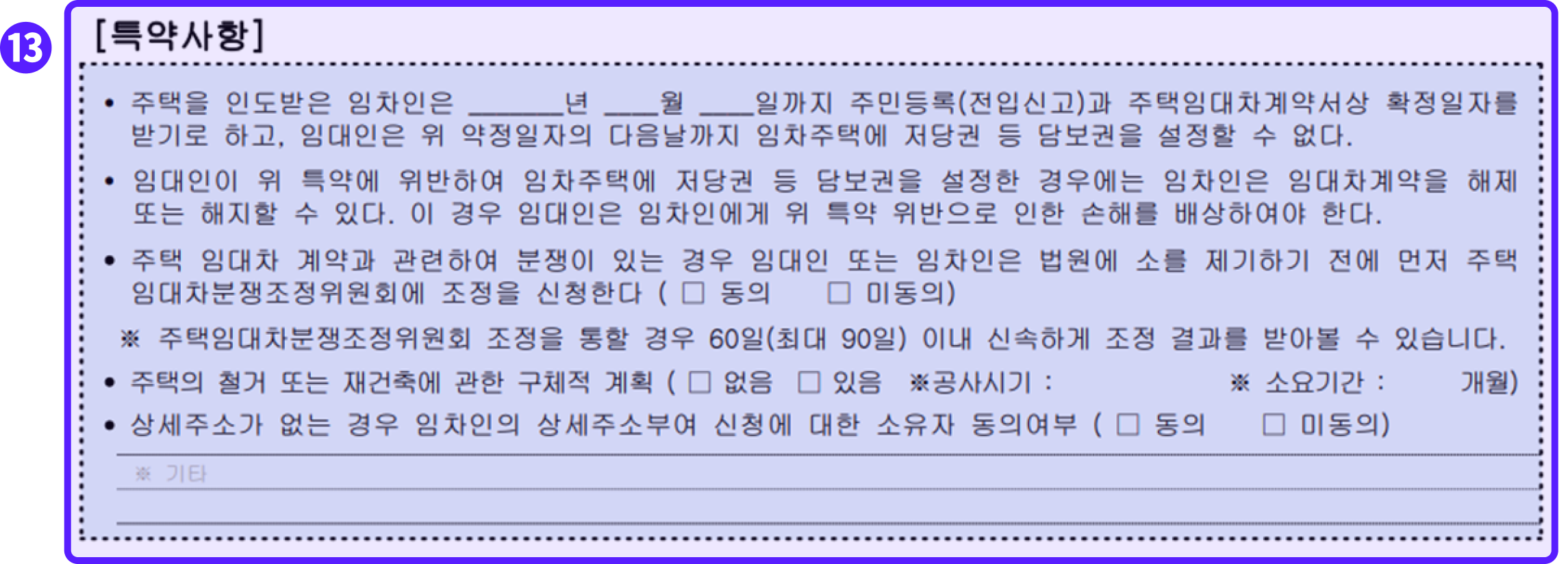
⑬ Special Agreements (특약사항)
This is the section where anything agreed outside the standard form gets written down. Common special agreements include:
- Confirming that the tenant will complete resident registration (체류지변경신고 for foreigners) and date confirmation (확정일자) by a specific date
- Agreeing that the landlord will not set new liens on the property after the contract is signed
- Confirming there are no demolition or reconstruction plans for the building
- Allowing or prohibiting subletting, pet ownership, or interior modifications
- Agreeing on specific items left in the unit (appliances, furniture)
⚠️ Read this section carefully. Landlords sometimes add clauses that limit tenant rights — for example, waiving the right to dispute maintenance fee increases, or agreeing to an abnormally short notice period for vacating. If you don't understand a clause in this section, ask your agent to explain it before signing.
Section 6: The Parties — Landlord, Tenant, and Agent
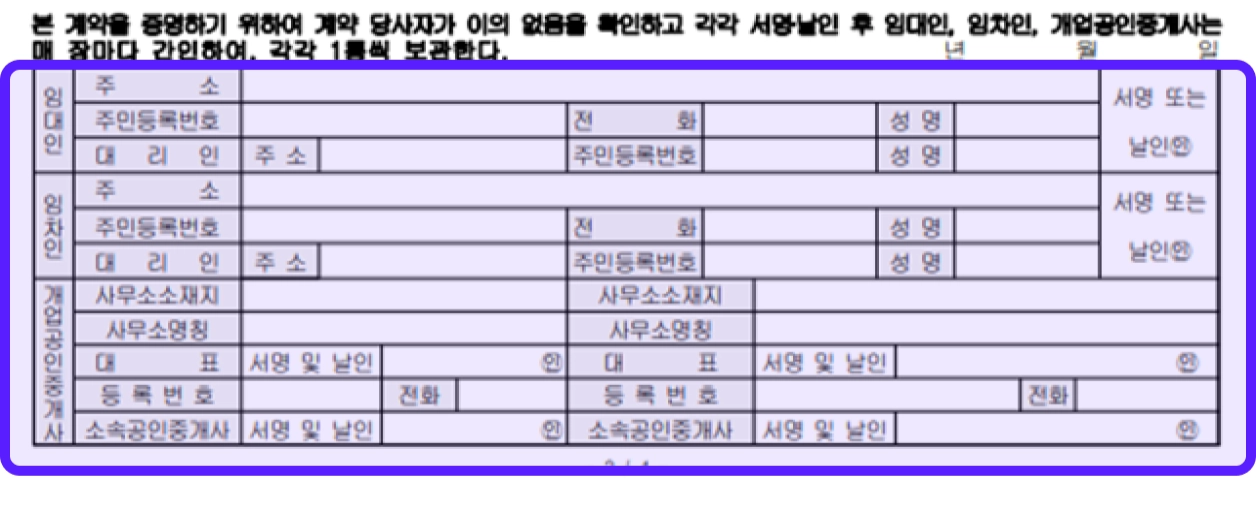
The final section confirms the identities of everyone involved:
- Landlord (임대인): Name, address, ID number — must match the property registry
- Tenant (임차인): Your name, address, passport/ARC number
- Certified Agent (개업공인중개사): Name, license number, office address, stamp
The agent's stamp (도장) at the bottom of the contract confirms that a licensed agent verified and facilitated the transaction. This stamp creates legal accountability — if the agent provided false information, they can be held liable. Contracts without an agent stamp offer you less recourse if something goes wrong.
The Three Clauses Most Foreign Renters Overlook
After working with thousands of foreign renters in Korea, these are the contract points that cause the most problems:
1. Usage type — make sure it says "residential" Check that the building is registered as residential (주거용), not commercial. This determines whether the Housing Lease Protection Act covers your deposit.
2. Maintenance fee breakdown "₩80,000 관리비" tells you nothing about what's included. Get the itemized breakdown before signing — electricity, gas, water, internet, and elevator fees are all handled differently in different buildings.
3. Early termination conditions Most contracts assume a 1–2 year tenancy. If you need to leave early, you need the landlord's cooperation and must typically give 3 months' notice. If this isn't workable for your situation, negotiate it into the special agreements section before you sign.
Korean rental contracts are manageable once you know what each section means. The standard form is actually designed to be tenant-friendly — the difficulty is that it's entirely in Korean. Reading legal Korean under pressure, with money on the line? You don't have to do this alone — get a CheckmateKorea manager to accompany you throughout the signing. Bring an expert to your signing →