
Deposit vs. Monthly Rent in Korea: How to Negotiate Wolse and Protect Your Money
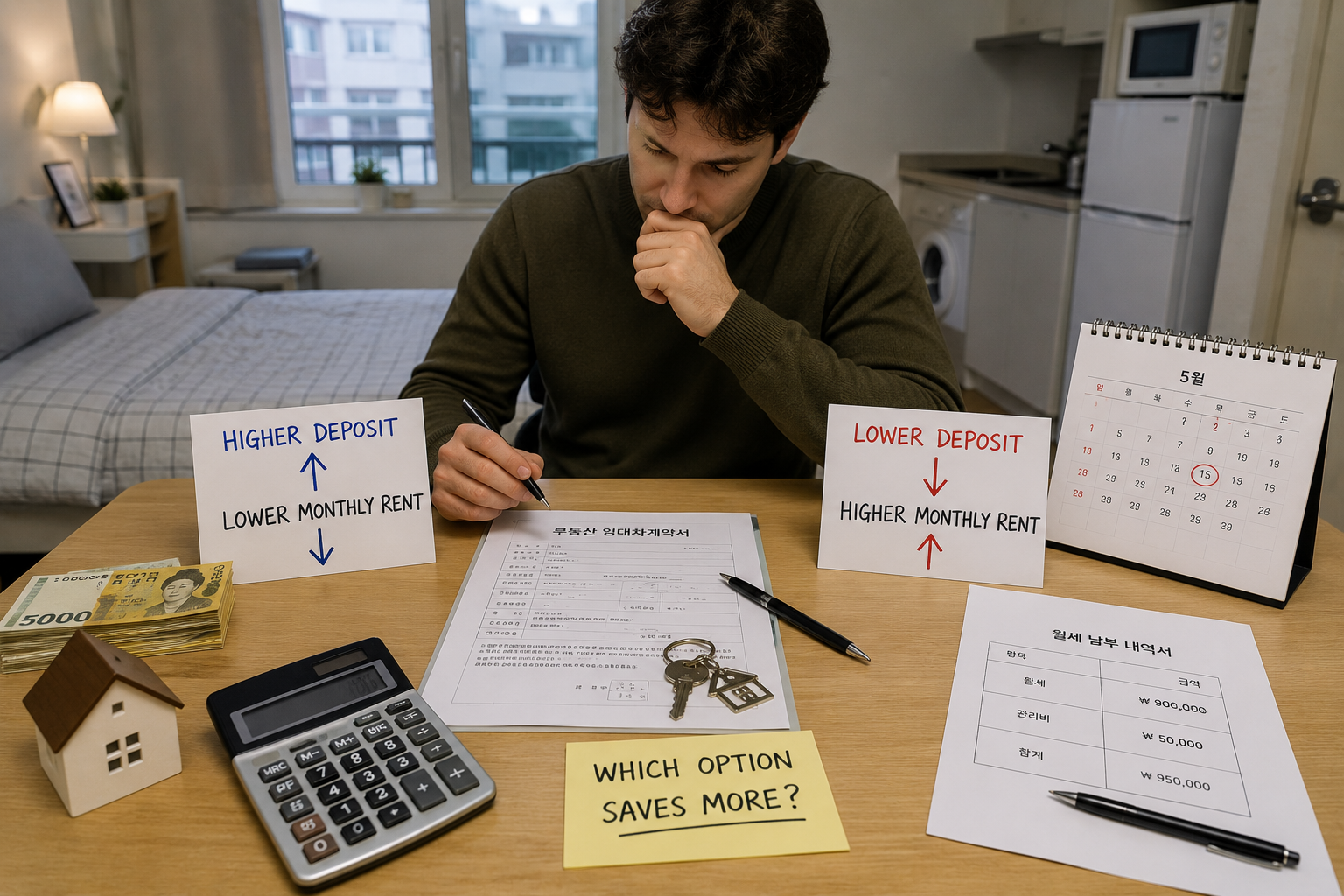
One thing that surprises almost every foreign renter in Korea: the deposit and the monthly rent are negotiable against each other. The same room can be ₩10,000,000 deposit with ₩500,000 rent, or ₩30,000,000 with ₩350,000, or ₩5,000,000 with ₩600,000. It's often the same landlord, the same room, the same day.
Once you understand the mechanics, this becomes a real tool — for lowering your monthly costs, and for overcoming landlord hesitancy about renting to a foreigner. It's also a way to expose a large amount of money if you do it carelessly.
The Mechanics
Korean rental housing runs on a spectrum:
- 전세 (jeonse) — a very large deposit, no monthly rent. The landlord invests the money and returns it at the end.
- 월세 (wolse) — a smaller deposit plus monthly rent. The standard for most foreign renters.
- 반전세 (semi-jeonse) — in between: a substantial deposit and reduced rent.
Between these, the deposit and rent convert at a rate called the 전월세전환율 (conversion rate). The principle is simple: increase the deposit, and the monthly rent falls by roughly what that additional money would earn.
A rough working example. If the conversion rate is around 5% annually, then adding ₩10,000,000 to your deposit should reduce monthly rent by about ₩40,000–₩45,000 (₩10,000,000 × 5% ÷ 12). Landlords vary and the rate moves with interest rates and the local market, but that's the shape of the calculation.
💡 Ask the agent directly: "보증금을 올리면 월세는 얼마나 내려가나요?" (If I increase the deposit, how much does the rent drop?) This is a completely normal question and the answer tells you the landlord's actual rate.
→ Jeonse vs Wolse: Korea's Rental System Explained for Foreign Renters
When a Bigger Deposit Makes Sense 👍
- You have the cash and you're staying a while. If you'll be in Korea two years, shifting ₩20,000,000 into the deposit to save ₩80,000 a month returns ₩1,920,000 across the lease. That's real money, and you get the deposit back.
- A landlord is hesitating about renting to you. This is the guarantor conversation in a different form. Rather than arguing about documentation, offering a higher deposit addresses the underlying worry directly — and it costs you nothing permanently.
- Your monthly cash flow is tight but your savings aren't. Students on scholarships and workers with savings abroad are often in exactly this position: enough capital, limited monthly income.
- You want to reduce risk of falling behind. A lower monthly payment is a smaller recurring obligation. If your income is uncertain, that matters.
When It's a Mistake
- When the property carries significant debt. This is the critical one. Even with 확정일자, if the landlord took out a mortgage before your tenancy, that lender ranks ahead of you. If the property is auctioned, the bank is paid first — and a larger deposit means more of your money sits behind theirs.
- Check the property register (등기부등본) before deciding how much to put down. A heavily mortgaged building is a reason to keep your deposit small, not to optimise your monthly rent.
- When you might leave early. Money in a deposit is money you can't access until the lease ends and the landlord returns it. If your stay is uncertain — a short visa, a fixed-term contract, a course that might not extend — a large deposit is capital locked into a situation you may need to exit.
- When You'll Be Leaving the Country at Lease End: Once you surrender your ARC at airport immigration, your legal address registration in Korea is automatically cancelled. You cannot easily enforce deposit recovery from abroad. Always schedule your lease termination and deposit return for the morning of your move-out before you leave for the airport.
- When it's all the money you have. An emergency in a foreign country with no accessible savings is a genuinely bad position. Don't optimise your rent down to the point where you have no buffer.
Protecting a Large Deposit
If you do go the large-deposit route, treat protection as part of the plan rather than an afterthought.
- Get 확정일자 immediately. You can do this the week you sign, with your passport — no ARC required, ₩600 at the local 주민센터. It fixes your priority date, and priority is what determines who gets paid first.
- Complete your address registration promptly. For foreign nationals this happens through foreign registration. Until it's done, you have 확정일자 but not full 대항력.
- Check the register before, not after. Existing mortgages, tax liens, and the building's valuation all determine whether your deposit is realistically recoverable.
- Consider Deposit Return Guarantee Insurance: HUG, HF, and SGI offer 전세보증금반환보증, which pays you if the landlord fails to return your money. While property debt levels determine eligibility rather than your nationality, to actually apply, you MUST have your ARC, completed address registration (체류지 변경 신고), and a Fixed Date (확정일자) stamp. Short-term visitors without an ARC are not eligible.
The Reverse Trade: Lower Deposit, Higher Rent
Less discussed, but equally useful for foreign renters.
If your deposit is the barrier — you can't raise ₩10,000,000 on arrival — you can ask to go the other direction: lower deposit, higher monthly rent.
Landlords are often less willing to do this than the reverse, since the deposit is their security. But it's worth asking, and some will accept with a modest rent premium.
When this is the right call:
- Your stay is short or uncertain
- You have income but not capital
- The property register shows debt you're not comfortable sitting behind
- You want to keep savings accessible
What it costs: more per month, and the total over a long stay exceeds what the higher-deposit route would have cost. That's the trade — liquidity and lower risk exposure, in exchange for higher running costs.
A Practical Way to Decide
Three questions, in order:
1. What does the property register say? Heavy prior debt caps how much you should reasonably put down, regardless of the arithmetic. Answer this first.
2. How long will you be here, and how certain is that? Long and certain favours a bigger deposit. Short or uncertain favours a smaller one, even at higher monthly cost.
3. What does the landlord's conversion rate actually work out to? Ask for the number, run the calculation across your lease term, and see whether the saving justifies locking up the capital.
If the answers point in different directions, weight the first one most heavily. Monthly savings are recoverable; a deposit lost to a foreclosure is not.
Working out the right deposit-to-rent balance means reading a property register and negotiating a conversion rate — in Korean, with a landlord. CheckmateKorea helps foreign residents with both, and explains what you're agreeing to.
- Jeonse vs Wolse: Korea's Rental System Explained for Foreign Renters →
- Renting in Korea Without a Guarantor or Korean Credit History →
- Your Deposit Is at Risk: What Foreigners Must Know About ARC →
- How to Read a Korean Property Register (등기부등본) →
- How Much Does It Actually Cost to Start Renting in Korea? →