
Signing a Lease in Korea: The Checklist Before You Commit

You found a room you like. The agent is friendly, the photos matched reality, and they're asking when you want to sign. Before you say yes, there's a set of checks that protect your deposit—and most of them take only a few minutes if you know what to look for.
This guide walks through everything to verify before you commit, from the person sitting across the table to the paper you're about to sign.
Why "before you sign" matters so much in Korea
In Korea, most of your money goes down as a deposit (보증금, bojeungeum)—often the equivalent of several months' rent, and in jeonse (전세) cases, tens of thousands of dollars. That money is only as safe as the contract and the property behind it.
Once you sign and transfer the deposit, your leverage drops sharply. Almost every protection you have is something you set up before signing, not after. That's why this checklist exists.
💡 A good agent won't be offended by these questions. Anyone who pressures you to skip them is a reason to slow down, not speed up.
Part 1 — Verify the person and the property
Is this person actually allowed to rent it to you?
The single most important check: the person signing must be the registered owner (or hold written authority from the owner).
| Check | How |
|---|---|
| Owner's name on the property record | Compare the 등기부등본 (property registration certificate) owner name against the landlord's ID |
| Landlord's identity | Ask to see their ID card; confirm the name matches |
| If it's an agent/proxy signing | Ask for a power of attorney (위임장), the owner's certificate of seal impression (인감증명서), and a copy of the owner's ID. (Make sure the seal on the certificate matches the seal on the power of attorney.) |
If any name doesn't line up, stop. This is the most common thread in rental fraud.
→ How to Read a Korean Property Register (등기부등본)
Is the property financially safe?
Pull the property registration certificate yourself (it's public—anyone can request it) and check two sections:
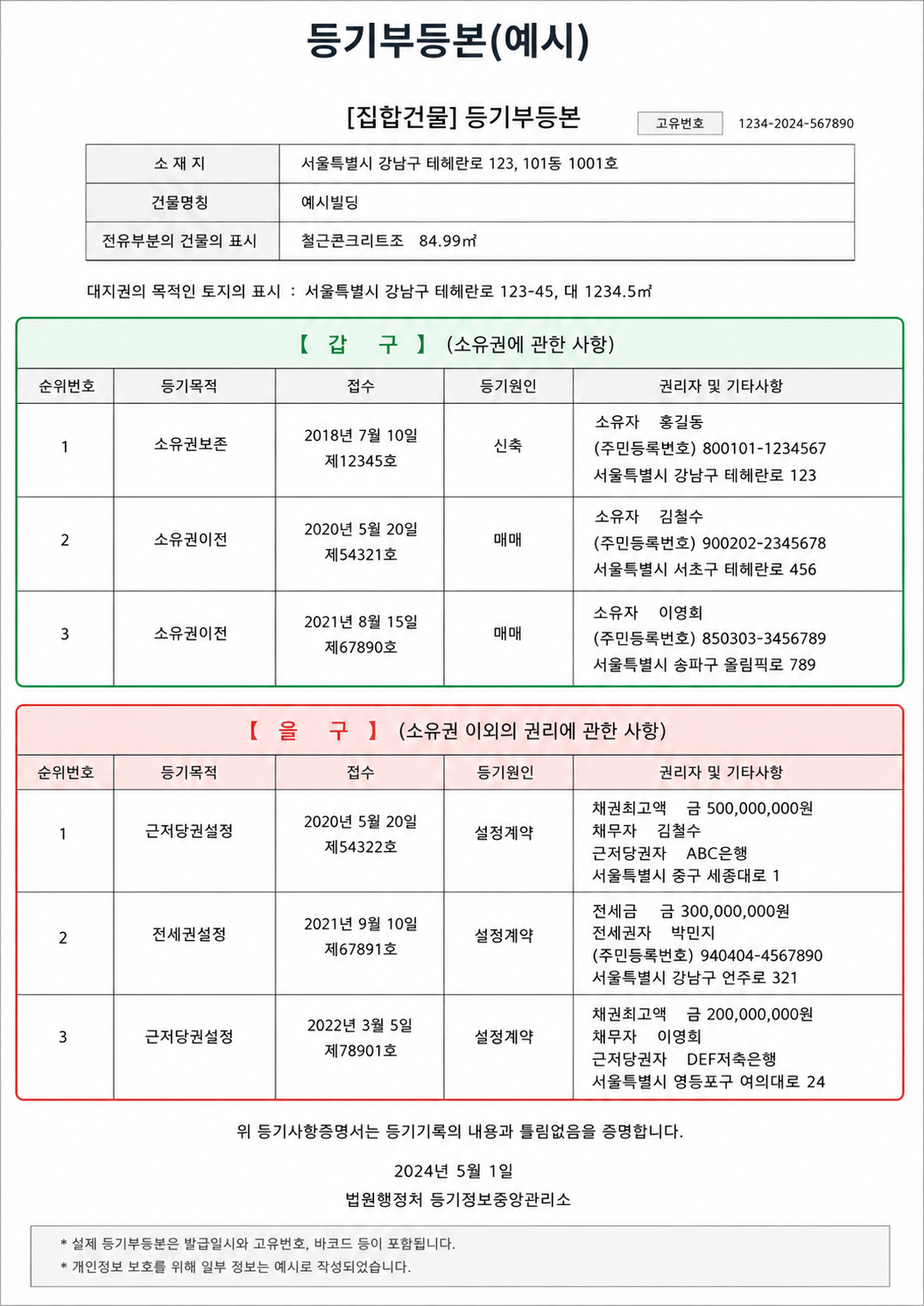
- 갑구 (Gap-gu / ownership section): any seizure (압류), provisional seizure (가압류), or auction notice is a red flag.
- 을구 (Eul-gu / other rights section): the total mortgage/loan amount (근저당 채권최고액). If that plus your deposit approaches or exceeds the property's market value, your deposit may not be recoverable if the property is auctioned.
⚠️ A rough rule many people use: if existing debt on the property plus your deposit is more than roughly 70–80% of the property's value, treat it as high risk. This is the classic "깡통 전세" (underwater lease) scenario.
Is the agency a licensed brokerage?
A licensed real estate office (공인중개사) must display its brokerage registration certificate (중개사무소 등록증) and the agent's license on the wall. A licensed transaction also comes with brokerage liability insurance (공제증서), which matters if something goes wrong.
→ Certified Agent vs Direct Deal: What Foreign Renters in Korea Need to Know
Part 2 — Read the contract itself
Korean lease contracts follow a fairly standard format. Before signing, confirm each of these fields is filled in correctly and matches what you agreed verbally.
| Field | What to confirm |
|---|---|
| Property address | Matches the registration certificate exactly, down to unit number |
| Deposit (보증금) & rent (월세) | Amounts and currency correct; payment dates written |
| Maintenance fee (관리비) | Amount stated, and what it includes (does it cover water? internet? cleaning?) |
| Lease term (계약 기간) | Start and end dates |
| Owner's name & account | Deposit should be sent to the registered owner's bank account, not a third party |
| Special terms (특약사항) | Anything you negotiated—repairs, appliances, move-in date—must be written here, not just promised |
💡 The 특약사항 (special terms) box is your friend. If the landlord promised to fix the boiler or leave the fridge, write it in. A verbal promise is very hard to enforce; a written one isn't.
The "what if I need to leave early" question
Ask this before signing, not after. In Korea, ending a lease before the term is up is generally the tenant's responsibility—you typically remain responsible for rent until a replacement tenant is found, and you may be asked to cover the new brokerage fee. It's not automatic that you get your deposit back the day you move out.
Knowing this upfront helps you decide on lease length honestly.
→ Early Lease Termination in Korea: What Foreign Renters Need to Know
Part 3 — Right after you sign (same day / next day)
Signing isn't the finish line. Two steps lock in your deposit protection:
- 확정일자 (fixed date stamp): Take your signed contract to a 주민센터 (community service center) or do it online. This timestamps your contract and sets your priority order if the property is ever auctioned. It is a separate step from your address registration—doing one does not do the other.
- 체류지변경신고 (change of residence report): As a registered foreign resident, you must report your new address within 15 days of moving in. This is not the same as a Korean citizen's 전입신고, and it's done at your 출입국·외국인관서 (immigration office), 시·군·구청, or 주민센터.
→ How to Register Your Address in Korea After Moving In: A Guide for Foreign Renters → Which Korean Government Office Do I Go To? 시청 vs 구청 vs 동사무소 vs Immigration
The one-page version
Before you sign, confirm:
After you sign:
Not sure you can check all this on your own—especially in Korean? That's exactly what Check With You Service is for. We go with you to viewings and the signing table, review the contract and the property record in Korean, and make sure nothing on this list gets skipped. Check With You Service →
If you've already found a place and just want a second set of eyes on signing day, or need help reviewing the contract, our contract accompaniment covers it perfectly. Contract Accompaniment Service →
- How to Read a Korean Property Register (등기부등본) →
- Certified Agent vs Direct Deal: What Foreign Renters in Korea Need to Know →
- Korean Rental Contract Explained: 13 Clauses Every Foreign Renter Must Understand →
- What to Prepare on Contract Day in Korea: A Checklist for Foreign Renters →
- Rental Scams in Korea: 5 Types Foreigners Fall For (And How to Avoid Them) →