
Mold and Condensation in Korea: Whose Fault Is It?
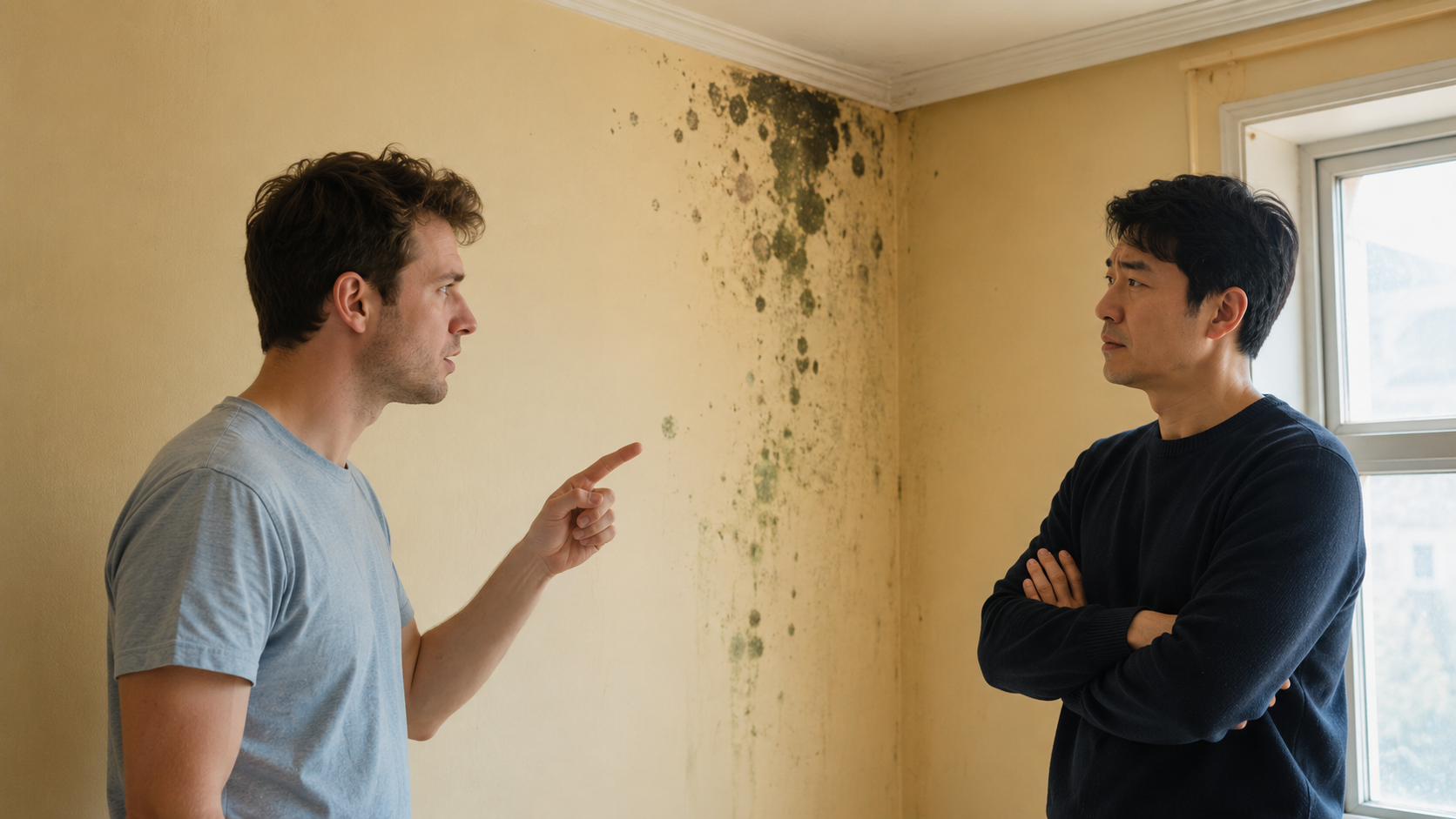
You find mold creeping across the bathroom ceiling, or black spots blooming behind the wardrobe, or condensation running down the inside of the windows every winter morning. The question that immediately follows is the one that causes disputes: is this the landlord's problem to fix, or yours?
In Korea, the answer depends on the cause — and cause is exactly what landlords and tenants argue about. This guide explains how responsibility is actually divided, and how to handle it without the dispute turning against you.
The Principle: Defect vs Lifestyle
Korean law makes the landlord responsible for keeping the property fit to live in, which covers mold caused by a building defect. But a tenant has a duty to use the home reasonably, which covers mold caused by how the space is used and ventilated.
So the dividing question is: did the building cause this, or did living habits?
| Cause | Usually responsible |
|---|---|
| Water leak (roof, pipes, external wall) | Landlord |
| Failed waterproofing (방수) | Landlord |
| Structural damp rising through walls | Landlord |
| No insulation / structural cold-bridging | Landlord |
| Condensation from not ventilating or heating | Tenant |
| Furniture pushed flush against a cold wall, blocking airflow | Tenant |
| Drying laundry indoors without ventilation | Tenant |
The difficulty is that these overlap. A poorly-insulated wall (landlord's issue) plus a tenant who never opens a window (tenant's issue) can produce the same mold — which is why these cases get contested.
→ You Moved In and Found a Problem: Repairs and Defects
Why Condensation Is Usually the Contested One
Most winter mold in Korean apartments starts as condensation (결로). Warm, moist indoor air hits a cold surface — a single-glazed window, an uninsulated external wall — and water forms. Left alone, that water grows mold.
The argument runs like this:
- The tenant says: the wall is cold because it's poorly insulated — a building defect. Landlord's problem.
- The landlord says: you don't ventilate, you dry laundry inside, you never run the heating — a lifestyle issue. Tenant's problem.
Often both are partly true. Korean courts and disputes look at the specific facts: how bad the insulation is, whether the tenant took reasonable steps to ventilate and heat, and whether the problem existed before the tenant moved in.
The practical takeaway: you strengthen your position enormously by showing you did your part — ventilating, heating reasonably, not blocking airflow. A tenant who can show reasonable use has a strong claim that remaining mold is a building defect. A tenant who kept the windows shut all winter has a weak one.
💡 Note on Banjiha & Oktapbang: Semi-basement (반지하) and rooftop (옥탑방) units are structurally far more vulnerable to moisture and condensation due to limited airflow or poor exterior insulation. If you live in these housing types, running a dehumidifier continuously and capturing move-in baseline photos is even more critical.
Protect Yourself From Day One
The single most important move happens before any mold appears: document the condition when you move in.
- Photograph and video every room on move-in day, with timestamps — especially bathrooms, window frames, wall bases, and behind where furniture will go
- If there's any existing mold or damp, photograph it and send it to the landlord immediately, in writing
- Keep that record
This is what protects you. If mold was there before you arrived, your move-in photos prove it's pre-existing — a building issue, not something you caused. Without that record, a landlord can claim you created it.
⚠️ Move-Out Deposit Risk (원상복구 의무): Under Article 615 of the Civil Act, tenants have a legal duty to restore the property upon moving out (원상복구의무). If severe mold is proven to be caused by tenant negligence (lack of ventilation or care), the landlord can legally deduct the cost of professional mold removal and wallpaper replacement (도배비) directly from your security deposit.
→ Apartment Viewing Checklist for Korea
What to Do When Mold Appears
1. Act early and document. Photograph it as soon as it appears, with dates. Mold spreads, and a record of when it started and how it progressed matters.
2. Do your part, visibly. Ventilate daily, run heating/dehumidifying reasonably, keep furniture slightly off external walls, don't dry laundry in an unventilated room. This both helps the problem and establishes that you're using the space reasonably.
3. Report it in writing. KakaoTalk, specific and factual: where the mold is, when it appeared, what you think is causing it. Attach photos. If you believe it's a building defect (a leak, failed waterproofing, no insulation), say so.
4. Ask for the appropriate fix. For a genuine building defect — a leak, failed waterproofing — that's a major repair and the landlord's responsibility, even against a general "tenant pays repairs" clause.
When It's Clearly the Landlord's
Some mold is unambiguously a building problem, and here you're on firm ground:
- A leak from the roof, an upstairs unit, or a burst/leaking pipe
- Failed waterproofing in the bathroom causing water ingress
- Structural damp rising through walls independent of your ventilation
- Mold that was there when you moved in (this is why the move-in record matters)
These are major repairs, and Korean law puts them on the landlord regardless of contract clauses shifting minor repairs to the tenant. If a landlord refuses a clear building-defect repair, the escalation path — written requests, a certified letter (내용증명), and free legal consultation — applies.
When It's Genuinely Shared
Sometimes it honestly is both — a somewhat cold wall and insufficient ventilation. In these cases the practical resolution is often a shared one: the landlord addresses the building side (better insulation, anti-mold treatment, a bathroom vent), and you commit to ventilation habits.
Going in with a cooperative "let's solve this together" framing, backed by evidence that you've done your part, tends to get a better outcome than a pure blame argument — especially when the facts are genuinely mixed.
Practical Prevention
Whoever's ultimately responsible, these reduce mold and strengthen your position:
- Ventilate daily, even briefly in winter — open windows to clear moist air
- Use the bathroom fan or open the window after showering
- Keep furniture a few centimetres off external walls so air can move
- Don't dry laundry in a closed, unventilated room
- Run a dehumidifier in damp months, or use moisture absorbers (제습제) in wardrobes
- Heat reasonably in winter — a never-heated room condenses more
The Short Version
Mold responsibility in Korea comes down to cause: building defects are the landlord's, lifestyle-driven condensation is the tenant's, and the common winter cases are contested because they're often both. Two things decide how it goes for you: your move-in record proving what was pre-existing, and your ability to show you used the space reasonably. Do both, report clearly in writing, and a genuine building defect is the landlord's to fix.
Arguing a mold dispute in Korean, where the outcome hinges on cause and evidence, is hard to do alone. Checkmate Korea's settlement support helps foreign tenants document, report, and resolve these with landlords. Get Settlement Support →
- You Moved In and Found a Problem: Repairs and Defects →
- Apartment Viewing Checklist for Korea →
- Renting a Banjiha (Semi-Basement) or Oktapbang (Rooftop) in Korea: Costs, Risks, and Legal Protection →
- Korean Rental Contract Explained: 13 Clauses Every Foreign Renter Must Understand →
- Your Korean Landlord Won't Return Your Deposit. Here's What to Do →