
How Your Visa Type Affects Renting in Korea
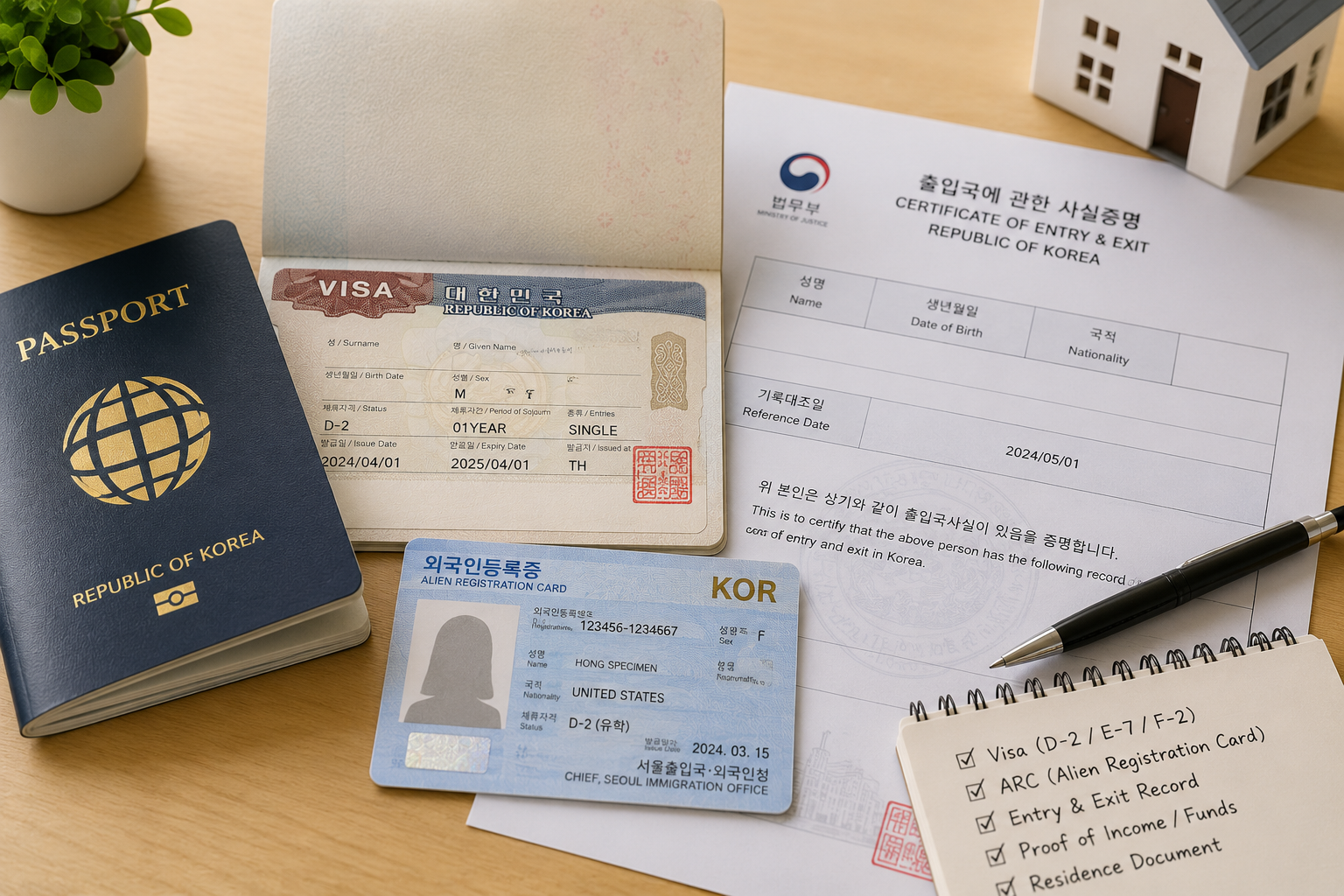
Most rental guides for foreigners in Korea treat everyone the same. In practice, your visa determines a surprising amount: how long a lease you can realistically sign, whether you can register your address at all, what a landlord will ask you for, and what happens to your deposit when your status changes.
This guide covers what actually differs by visa type, and what to do about it.
The Chicken-and-Egg Problem Everyone Hits First
Before anything else, understand the sequence problem that catches nearly every new arrival.
To get your ARC (외국인등록증), you must register as a foreign resident within 90 days of entry. The required documents include proof of your address (체류지 입증서류) — typically a lease contract, a certificate of accommodation from your housing provider, or a utility bill.
But the ARC is what unlocks almost everything else in Korean daily life: a bank account, a phone contract, health insurance. And landlords frequently want to see an ARC before signing.
So the order runs: housing → ARC → bank account and phone. Not the other way around.
This is why arriving without accommodation arranged is harder than it looks. You need somewhere to live in order to prove where you live in order to get the card that makes normal life possible.
💡 Practical implication: if you're arriving on a long-stay visa, secure housing before or immediately on arrival — and make sure the place will let you register your address there. A room that won't allow address registration creates a problem that has nothing to do with the room.
Timing to plan around:
- ARC application deadline: within 90 days of entry
- Card issuance: typically 3–5 weeks after applying
- Address registration after moving: within 15 days
- Missing the 90-day deadline: fines up to ₩1,000,000
D-2 (Degree Student)
Typical stay: up to 2 years per grant, renewable through your degree
D-2 is the most straightforward student position for renting. Your permitted stay is long enough that a standard 12-month lease fits without difficulty, and landlords generally treat degree students as stable tenants.
What works in your favour: a multi-year course means you're not asking a landlord for anything unusual. Your university enrolment certificate is useful documentation.
What to watch: your visa renewal cycle and your lease cycle won't align automatically. If your D-2 is renewed annually and your lease runs on a different schedule, you can end up renewing a lease while your visa status is still pending. Plan the two together.
→ Housing Near Seoul's Top Universities: Real Rent Costs by Campus
D-4 (Language Student)
Typical stay: up to 2 years per grant, but courses often run in 10-week blocks
D-4 is where visa and housing collide most often, because the mismatch is structural: language programmes are sold in ten-week semesters, while the rental market sells twelve-month leases.
Students commonly register for two semesters at a time — many universities only issue the Certificate of Admission required for a D-4 if you register for two or more — which means roughly six months in Korea against a twelve-month lease standard.
The practical consequences:
- A 12-month lease may outlast your enrolment. Don't sign one assuming you'll break it later — early termination in Korea is the tenant's responsibility and cost.
- Short-stay housing types (share house, goshiwon, short-term one-room) fit D-4 timelines far better than standard leases.
- If you might extend your studies, ask for an extension option in the contract when you first sign — course registration and visa results usually come too late to renegotiate housing comfortably.
→ D-4 Language Students: Finding Housing That Fits Your Course → Early Lease Termination in Korea: What Foreign Renters Need to Know
E-Series (Working Visas: E-7, E-2, E-9 and others)
Typical stay: tied to your employment contract
Working visa holders have the strongest position with landlords — you have income, an employer, and documentation — but you also have the tightest coupling between your job and your housing.
What works in your favour: employment contracts and certificates of employment (재직증명서) are exactly what landlords want to see. Income is the single most reassuring thing you can show.
What to watch:
- Your visa is tied to your employer. If you change jobs, your status requires action, and a landlord who checks may see that as instability mid-lease.
- If your employment ends, your housing situation becomes urgent in a way it doesn't for students. Understand your lease's termination terms before you need them.
- Company-provided housing (사택) is common, but if it's in your employer's name, you have no lease of your own and no deposit protection of your own. If you leave the job, you leave the flat.
→ Renting in Korea Without a Guarantor or Korean Credit History
Short-Term Visas (C-3, Visa-Free Entry)
Typical stay: up to 90 days
This is the significant one, and it's frequently misunderstood.
On a short-term visa, you cannot register as a foreign resident and therefore cannot get an ARC. Foreign registration is for people staying more than 90 days. Without an ARC, you cannot register your address, which means:
- No Address Registration Means Incomplete Legal Protection: Because foreign registration is unavailable for short stays under 90 days, you cannot perform address registration (체류지 변경 신고). While you can technically get a Fixed Date (확정일자) stamp with your passport, without address registration, your full legal priority (대항력) cannot be activated. Most landlords also avoid signing standard leases for short stays.
- Bank accounts and phone contracts are largely unavailable
What this means practically: for stays under 90 days, use accommodation that doesn't require a lease — guesthouses, monthly-rental serviced rooms, goshiwon, share houses. Do not put a large deposit into a standard lease that you cannot legally protect.
⚠️ Practical Risk: If you sign a standard lease and pay a large deposit on a C-3 or tourist visa, understand that your deposit sits outside full statutory legal protection. For short-term stays, it is far safer to stick to low-deposit options like goshiwons, share houses, or serviced rentals.
What Landlords Actually Ask For
Regardless of visa type, expect some combination of:
| Document | Who has it easily | Notes |
|---|---|---|
| Passport | Everyone | Always required |
| ARC (외국인등록증) | Long-stay visa holders after registration | Frequently requested; not always mandatory |
| Certificate of enrolment (재학증명서) | D-2, D-4 | Substitutes for income for students |
| Certificate of employment (재직증명서) | E-series | The strongest document you can show |
| Proof of income or bank balance | E-series easily; students rarely | Often the actual sticking point |
| Guarantor (연대보증인) | Almost nobody new to Korea | The most common barrier |
The last two rows are where most foreign renters get stuck, and it's not really a visa problem — it's a credit-history problem. Korea's rental system assumes a tenant with a Korean financial record, and new arrivals don't have one regardless of status. → My Korean Landlord Won't Rent to Foreigners: What to Do
When Your Visa Changes Mid-Lease
Three situations worth planning for.
- Extension. Straightforward, but the paperwork requires proof of your address — so keep your lease documents accessible and your address registration current.
- Change of status (e.g., D-4 → D-2, or student → E-7). Your registration details change, and you'll need to update accordingly. Your lease itself doesn't automatically change, but the documentation supporting it does.
- Expiry / Departure without renewal: When you permanently leave Korea and hand back your ARC at airport immigration, your registered address is automatically cancelled by law. Your best protection is ensuring your deposit is returned on your move-out morning BEFORE going to the airport.
If your contract period has officially ended and the landlord refuses to return the deposit, there is a court procedure called 임차권등기명령 (Leasehold Registration Order) that can preserve your legal claim on the property register even after departure. Note that this can only be filed AFTER your contract end date has officially passed.
→ Visa Extension and Address Change in Korea: What to Update, and When → Leaving Korea at the End of Your Semester: Getting Your Deposit Back After You Fly Home
The Short Version
| Visa | Realistic lease length | Address registration | Main challenge |
|---|---|---|---|
| D-2 | 12 months, comfortably | Yes | Aligning renewal with lease cycle |
| D-4 | 4–12 months, depends on enrolment | Yes | Course length vs lease length |
| E-series | 12 months+ | Yes | Housing tied to employment |
| C-3 / visa-free | None — avoid standard leases | No | No deposit protection |
Your visa doesn't change the rental market, but it does change which parts of it are available to you and what you should be careful about. The two things that matter most across every category: confirm you can register your address at the property before you sign, and don't commit to a lease term longer than your legal right to stay.
Navigating a Korean lease while also navigating Korean immigration paperwork is a lot at once. CheckmateKorea helps foreign residents find housing that fits their visa situation with contract support and settlement help.
- Renting Before You Get Your ARC: What's Actually Possible →
- D-4 Language Students: Finding Housing That Fits Your Course →
- Visa Extension and Address Change: What to Update and When →
- Renting in Korea Without Korean: Why Most Foreigners Shouldn't Do It Alone →
- How to Register Your Address in Korea After Moving In: A Guide for Foreign Renters →