
Moving House in Korea: Types of Movers, Costs & Large Waste Disposal
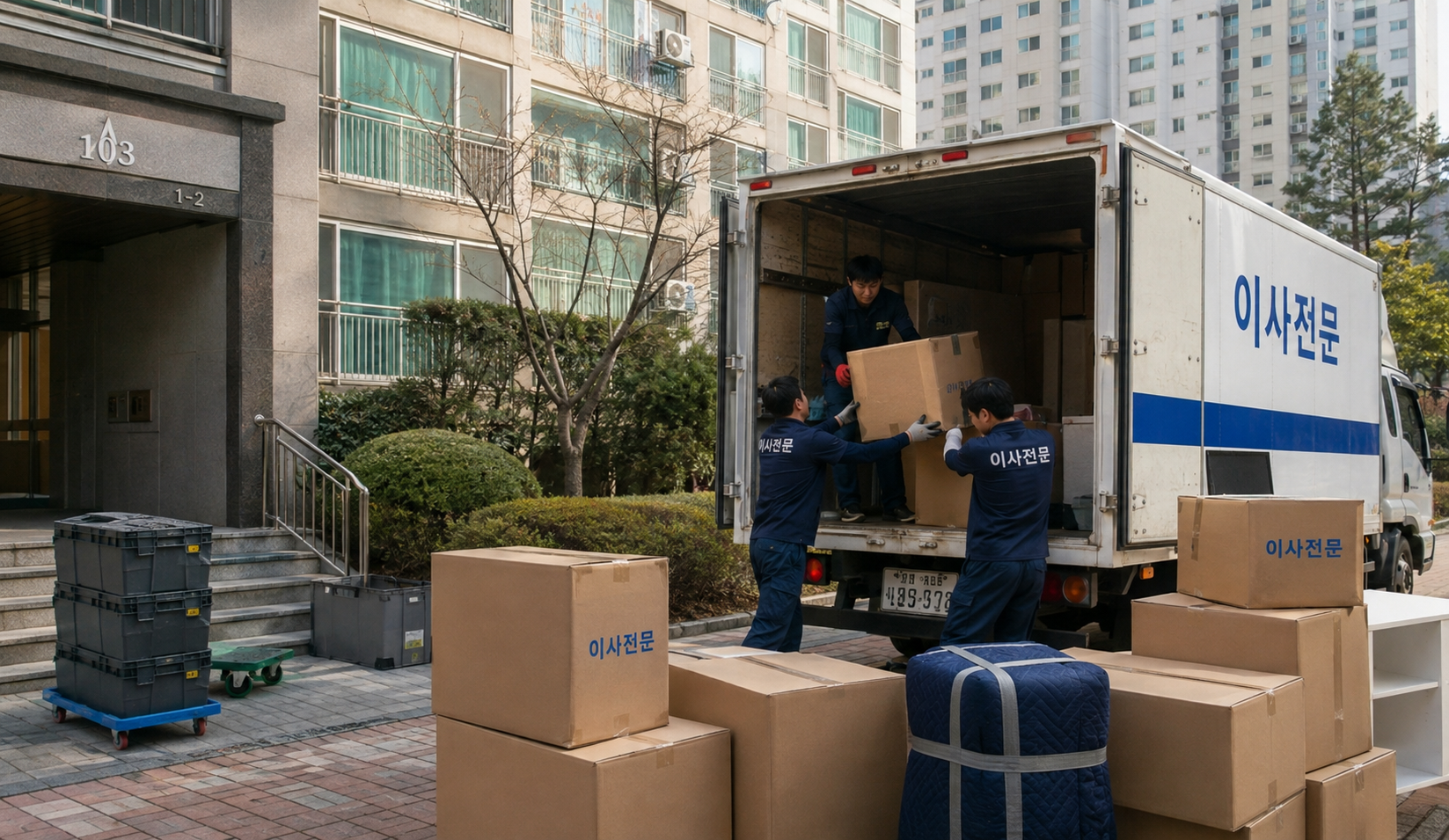
Moving day in Korea has its own systems — a very good full-service moving option most newcomers don't know exists, specific rules for throwing out furniture, and a sequence of things that have to line up on the day. Getting it right makes moving genuinely painless; getting it wrong means a sofa you can't dispose of and a deposit held up over a mess.
This guide covers how to move house in Korea as a foreigner: your options, what they cost, and how to handle the stuff you're not taking.
Your Moving Options
Packing move (포장이사) — the full-service option
This is the one worth knowing about. A 포장이사 (packing move) is an all-in service where the movers pack everything, transport it, and unpack it at the other end. They bring the boxes, wrap your belongings, load, drive, unload, and set your things back up — furniture reassembled, often even dishes back in cupboards.
For anyone who dreads moving, this is transformative. You essentially point at your stuff and it reappears, arranged, in your new place. It's the standard choice for Korean households moving home, and it's very good.
Semi-packing (반포장이사)
A middle option: you pack your own boxes, the movers handle transport, loading, and the heavy items. Cheaper than full packing, more work for you.
Regular move (일반이사)
Just transport — the movers move what you've already packed and carried out. Cheapest, most work, suitable if you have little and a tight budget.
For a small room: a one-ton truck (용달)
If you're a student or single person with minimal belongings, a 용달 (small truck with a driver) can be enough — you load with help, they drive. The cheapest option for a light move.
What It Costs
Rough ranges — moving costs vary by volume, distance, floor, elevator access, and season:
| Type | Rough cost |
|---|---|
| 용달 (small truck, minimal stuff) | ₩100,000 – ₩300,000 |
| Regular move (일반이사) | ₩300,000 – ₩600,000 |
| Semi-packing (반포장) | ₩400,000 – ₩800,000 |
| Full packing move (포장이사) | ₩600,000 – ₩1,500,000+ |
What drives the price up: more belongings, long distance, no elevator (carrying up stairs), a high floor needing a ladder truck (사다리차), and peak moving season.
💡 Timing affects price. Moving demand spikes around "good luck" moving days (손 없는 날 — traditionally auspicious dates) and month-ends. If you can move on an ordinary weekday mid-month, it's cheaper and easier to book.
Get a few quotes. Prices vary between companies, and many will do a video or in-person survey of your belongings to quote accurately. Moving-comparison platforms exist, though most are Korean-only — a translation app helps.
Getting Rid of Large Items (대형폐기물)
This is where foreigners most often get stuck. You cannot simply leave furniture or appliances out with the trash. Disposing of large items has its own process.
How it works:
- Report and pay for disposal via your district office (구청) website, dedicated apps (like 빼기 or 여기가), or simply purchase a sticker with cash at a local convenience store (편의점) and attach it to the item.
- Pay the disposal fee — it varies by item (a desk might be ₩2,000–₩5,000, a wardrobe or fridge more)
- Get a sticker or number — you either print/receive a sticker or write the issued number on the item
- Put it out at the designated spot on the arranged date
Leaving a large item without this — dumping a mattress by the bins — is illegal dumping (무단투기) and carries a fine.
→ Trash, Recycling, and Food Waste in Korea: A Guide for Foreigners
Alternatives to paying for disposal:
- Sell or give away — secondhand apps (Karrot / 당근마켓 is the big one) are where people offload furniture and appliances, often free for pickup. A day or two before moving, listing your unwanted items free "for pickup" often clears them
- Some movers take items away for a fee as part of the move — ask when getting quotes
- Donation — some organisations collect usable furniture
The Moving-Day Sequence
Several things have to line up, especially because your deposit is tied to leaving the old place properly.
At the old place:
- Movers load everything
- Final meter readings — electricity, gas, water — and settle final bills or agree deductions
- Large-item disposal handled (before or on the day)
- Clean as your contract requires (see below)
- Photograph the empty unit (timestamps) — your evidence on condition
- Hand over keys only after deposit return and settlements are confirmed
→ Korean Apartment Move-Out Restoration Guide: What You Owe vs. Normal Wear
At the new place:
- Movers unload and (for 포장이사) unpack and set up
- Check the room's condition and photograph it on move-in — your protection for next time
- Confirm utilities are working (usually already connected through the building; individual gas accounts may need a scheduled visit)
Within the deadlines after:
- Address registration (체류지변경신고) within 15 days
- 확정일자 on your new contract — passport is enough
- Update the lease report if applicable
→ How to Register Your Address in Korea After Moving In: A Guide for Foreign Renters
Utilities When You Move
Here's where expectations from other countries can mislead you. In Korea, how utilities are handled varies by building and contract, and it's worth confirming your specific setup rather than assuming.
In many rentals — especially one-rooms, officetels, and villas — the building already has electricity, gas, and water connected, and you're billed for your unit's usage each month rather than holding accounts in your own name. In that common setup, moving out isn't about disconnecting services — it's about settling your final usage, calculated from your meter reading, often prorated to your move-out date. You either get a final bill or the landlord or management office tallies it and lets you know.
But this isn't universal, so the practical approach is to ask your landlord or management office how each utility is handled for your specific unit:
- Electricity, gas, and water. Confirm whether these are billed through the building or held in your name. If through the building (common), there's usually nothing to "close" — just make sure the final meter readings are recorded on move-out day so you're charged for your usage and no more. If any are in your own name—individual city gas accounts are the most likely—a technician must visit to disconnect/reconnect the valve safely. Book this at least 2–3 days before moving day via your local gas provider, as same-day appointments during peak moving days are almost impossible to get.
- Internet. This is sometimes your own contract, sometimes included through the building — it varies. If it's yours, it's often a 12–24 month contract with early-termination fees, and you can usually transfer it to the new address (사용 중지 없이 이전), which tends to be cheaper than cancelling. If it's provided through the building, you may have nothing to arrange. Check which applies before you move.
💡 The reliable approach: rather than assuming, ask your landlord or management office how electricity, gas, water, and internet are each handled for your unit, and what you need to do on move-out. For most people it comes down to settling final usage and confirming meter readings — but confirming beats guessing.
The Costs Nobody Warns You About
Beyond the movers, moving out involves several settlements that quietly come out of your pocket or your deposit. Knowing them means no surprises on the day.
Prorated final bills (일할 계산). You don't pay a full month for a partial month. Your final electricity, gas, water, and maintenance fee (관리비) are prorated to your actual move-out date — calculated by the days you were there. For 관리비, the building management office does this calculation; for utilities, the final meter reading sets it. Ask for the prorated figures rather than accepting a full-month charge.
Move-out cleaning fee (퇴실 청소비). Many contracts — and many landlords — expect the unit to be professionally cleaned when you leave, or deduct a cleaning fee from your deposit if it isn't. This is common enough to budget for: a studio cleaning typically runs ₩100,000–₩200,000, more for larger units. Two options:
- Arrange it yourself — often cheaper, and you control the quality. Book a move-out cleaning (입주청소/퇴실청소) service for after the movers empty the place.
- Let the landlord deduct it — simpler, but you don't control the cost. If it's coming out of your deposit, ask for the amount in advance.
- Check your contract's 특약 — if a specific cleaning fee was agreed, that governs.
Maintenance deposit refund (관리비 예치금). Some buildings collected a small refundable management deposit when you moved in. If yours did, it comes back on move-out — ask the management office so it isn't forgotten.
Internet early-termination fee. If your internet is your own contract and you can't transfer it, cancelling mid-term carries a penalty. Factor it in, or transfer instead. (If internet is provided through the building, this won't apply.)
Unpaid 관리비 or utilities. Any outstanding balance is typically settled from your deposit before the rest is returned. Clear what you can in advance so your deposit comes back clean and fast.
💡 Do the settlement math before move-out day. Prorated 관리비 and final utilities, minus any cleaning fee and outstanding balances, plus any maintenance deposit back — get these figures from the management office and landlord a few days ahead, so nothing holds up your deposit or catches you off guard.
→ How to Pay Electricity, Gas, and Water Bills in Korea: A Guide for Foreign Renters
→ Korea Apartment Maintenance Fee (관리비): What's Actually Included
The Short Version
Moving in Korea is easier than most places once you know the options: a 포장이사 does everything for you, down to unpacking, and it's the standard for good reason. The part that catches foreigners is large-item disposal — you can't just leave furniture out; report it and pay a small fee, or give it away free on Karrot. Line up your movers and disposal, get your final bills prorated, budget for a move-out cleaning fee, settle utilities, and handle your address registration within 15 days after. Do that and moving is genuinely smooth.
Coordinating a move, disposal, and deposit settlement in Korean is a lot at once. CheckmateKorea helps foreign residents through moving and settling in — from one place to the next.
- Korean Apartment Move-Out Restoration Guide: What You Owe vs. Normal Wear →
- Korea Move-Out Guide: How to Get Every Won of Your Deposit Back →
- Trash, Recycling, and Food Waste in Korea: A Guide for Foreigners →
- How to Pay Electricity, Gas, and Water Bills in Korea: A Guide for Foreign Renters →
- Korea Apartment Maintenance Fee (관리비): What's Actually Included →