
How to Use a Korean Boiler and Ondol Heating: A New Tenant’s Guide
Every Korean studio and one-room has a wall panel by the front door with buttons like 난방, 온수, and 외출 — and almost no one explains what they do before you move in. Get it wrong in winter and you can end up with a cold floor or no hot water.
This guide explains how Korean floor heating (ondol) actually works, what each mode does, and what to check before your first winter — plus a few things most guides get wrong.
How Ondol Actually Works
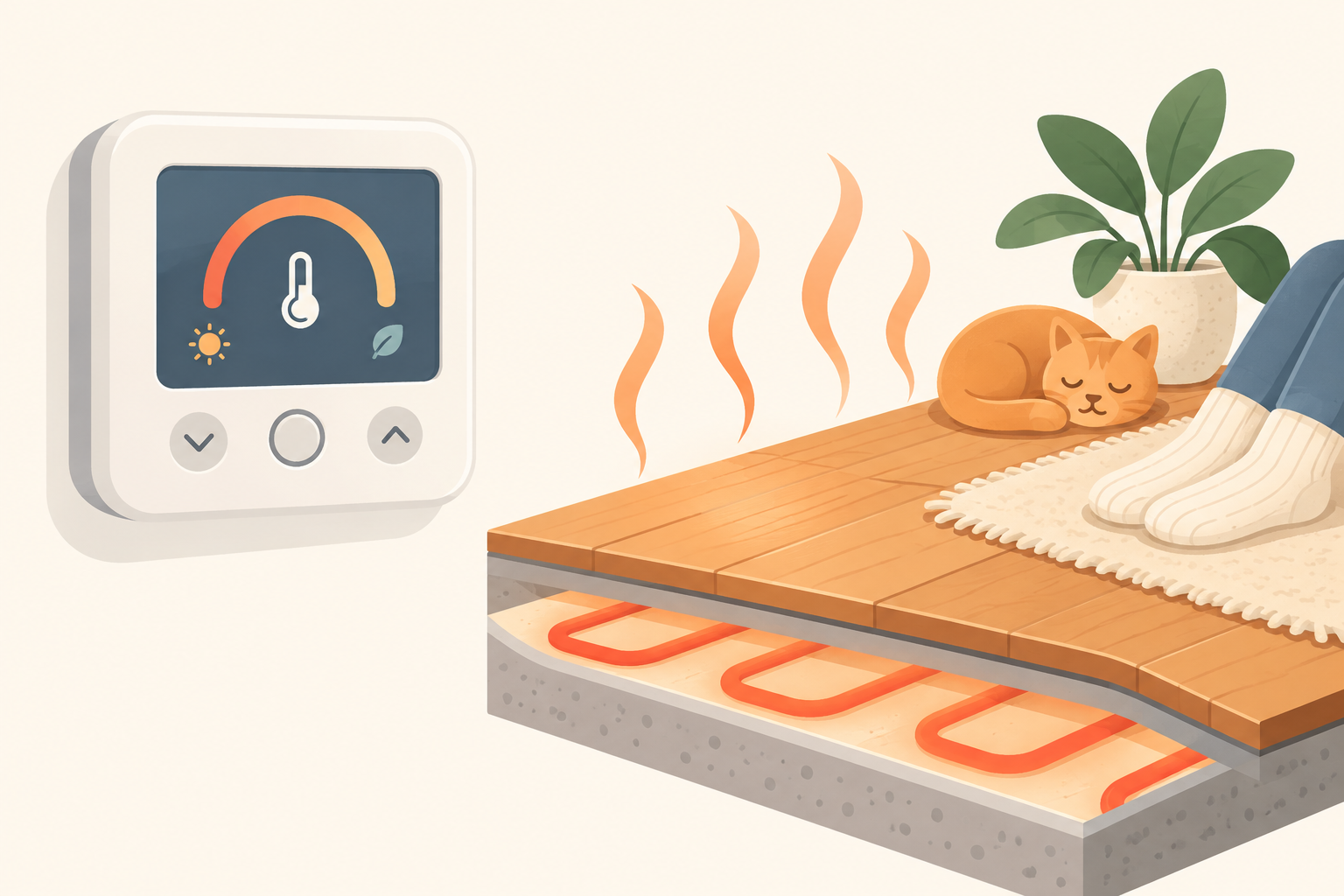
Modern Korean ondol (온돌) is hydronic radiant floor heating — completely different from Western radiators or forced-air heating. A boiler (보일러), almost always gas-powered, heats water that circulates through pipes embedded under your floor. The heat comes up from the ground, not from vents or a radiator.
A wall-mounted controller near your entrance lets you set the floor/room temperature, hot water temperature, and timers. Inside the boiler, a component called a three-way valve switches hot water between the floor-heating loop and your hot water taps — so the two functions aren’t fully independent. This is why running a shower can briefly affect your floor heating.
The Control Panel Terms You Need to Know
Button layout and icons vary by brand (Kyungdong Navien, Rinnai, Daesung Celtic, Guiwon are the most common), but these terms mean the same thing across all of them:
- 난방 (Heating): turns floor heating on/off.
- 온수 (Hot water): heats water for your shower and kitchen tap.
- 온수전용 (Hot water only): heats tap water without running the floor heating — the setting most people want in summer.
- 외출 (Away): a low-power mode — see below, it’s not what most people think.
- 예약 (Timer): schedules heating to run for set periods automatically.
Some (not all) panels also let you choose between 실내온도 (room temperature — a sensor reads the air) and 온돌온도 (floor temperature — the boiler targets the water temperature directly). If your panel has both: 실내온도 works well in a normal room, while 온돌온도 is worth using in a drafty room or one with large windows, since it isn’t thrown off by cold air near a window.
What 외출 (Away) Mode Actually Does
Most guides describe 외출 as a simple energy-saving mode for when you're out. That's not quite right. 외출 mode doesn't turn the heat off — it keeps the circulation pump running and fires the boiler briefly only if the water temperature drops toward freezing, mainly to protect the pipes. Indoor temperature under 외출 mode commonly drops below 10°C.
💡 Korean boiler-industry sources note that for short outings, switching to 외출 isn't actually more efficient — reheating a fully-cooled room afterward takes a large burst of fuel that can offset the savings. For a few hours out, just lower your target temperature by 2–3°C instead. Save 외출 mode for genuinely long absences, such as 3 days or more.
If You Have No Hot Water
- Frozen pipes: the most common winter cause, especially if piping runs through an unheated area like a ground-level parking floor (필로티). Cold water may still work while hot water fails, since the hot-water branch runs through the boiler unit.
- Simple causes to check first: the wall controller is powered off, the hot water temperature is set too low, or tap flow is too strong for the boiler to keep up — try reducing the flow rate.
- Gas supply issues: a closed gas meter valve or mid-line valve is a common, simple cause — see the section below.
If your boiler shows an error code, the general categories are: ignition failure (usually a gas supply issue), overheat (often a closed or blocked heating valve), water shortage (frozen pipes, a building water outage, or a leak), and gas-leak sensor errors. Exact code numbers differ by brand. If you smell gas, or see a gas-leak error, turn off the controller, close the gas valve, ventilate, and call a professional immediately — don’t just reset the unit.
💡 A tenant can usually check valves and thaw an exposed frozen pipe (a hair dryer or warm towel on the valve — never boiling water directly). Ignition faults, gas-leak errors, or anything requiring opening the boiler unit should go to a professional or your landlord — don’t attempt these yourself.
Before Your Gas Even Works: The Safety Inspection
Korean law requires city gas companies to run a safety inspection before activating gas service for a new tenant — gas accounts are usually closed when a previous tenant moves out rather than transferred directly to you. In practice, this means you often need to contact your regional city gas company yourself to schedule a technician visit before your heating and gas stove will work at all. Book this well before your move-in date, since inspectors generally only work weekday business hours — a weekend move-in can mean waiting until the next business day for gas.
💡 Electric boilers skip this step entirely — no gas company inspection is needed, which is one practical advantage of officetels or studios with electric heating.
Safety: Carbon Monoxide
The real safety risk with gas boilers is carbon monoxide leaking from a disconnected or damaged exhaust pipe (배기통), not the gas itself. Korean safety authorities recommend keeping your boiler’s exhaust vent unobstructed at all times, periodically checking that the exhaust pipe hasn’t come loose or been blocked, and installing a CO detector. If the unit makes unusual noise, smells odd, or overheats during use, stop using it and call a professional rather than troubleshooting it yourself.
Once you understand the panel, your Korean boiler is genuinely simple to run day to day. The main things to get right early are booking your gas safety inspection ahead of move-in and knowing that 외출 mode is for real absences, not a quick trip out.
Still searching for a place to live? Browse verified, foreigner-friendly rooms on CheckmateKorea →