
Health Insurance in Korea: A Guide for Foreign Residents
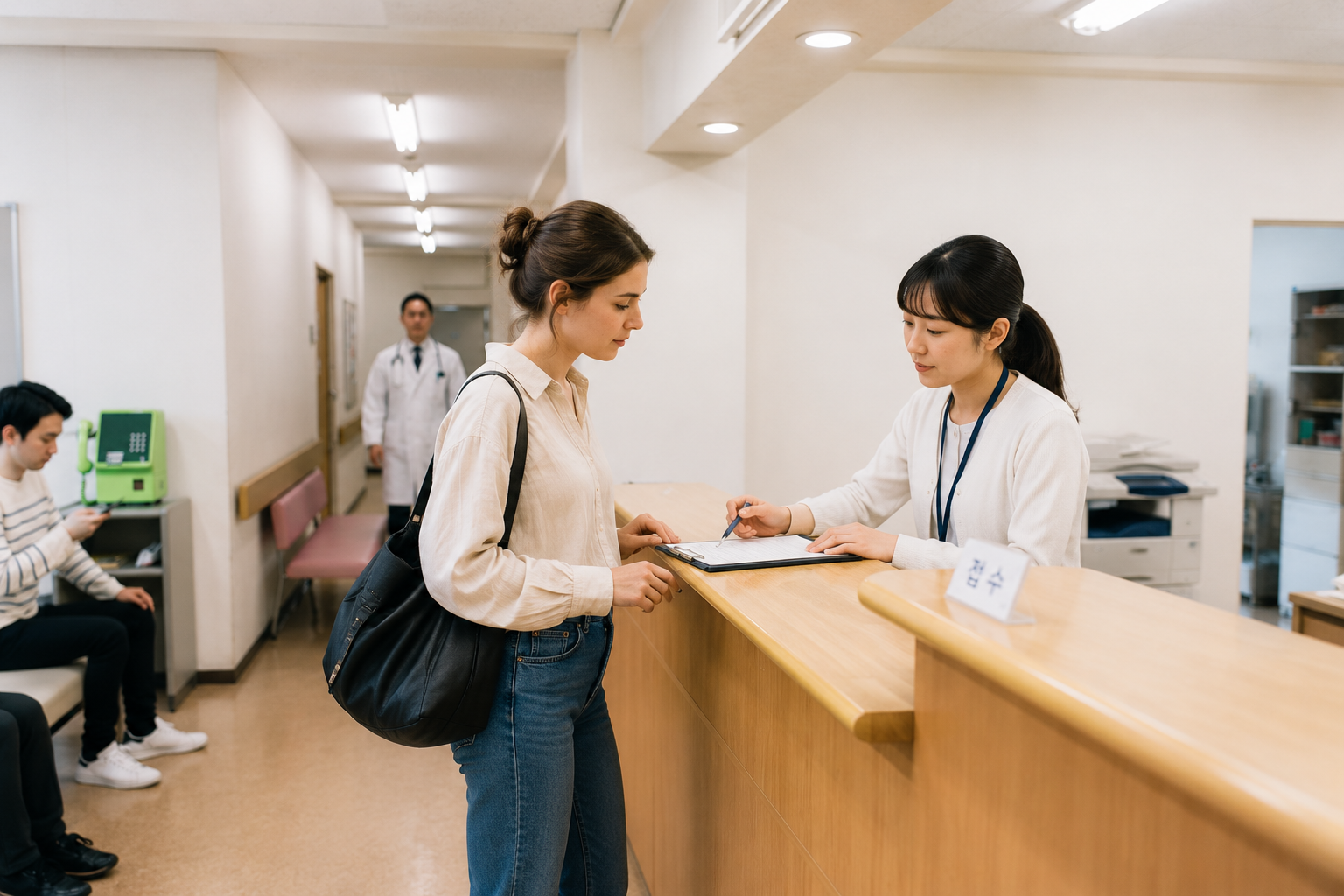
If you're staying in Korea for a while, you'll be part of the National Health Insurance system (국민건강보험, NHI)—usually whether you choose to or not. It's what turns a hospital visit from a scary bill into a manageable one.
This guide explains who has to enroll, how you get enrolled, roughly what it costs in 2026, and the discounts and exceptions worth knowing.
The basics: who has to enroll
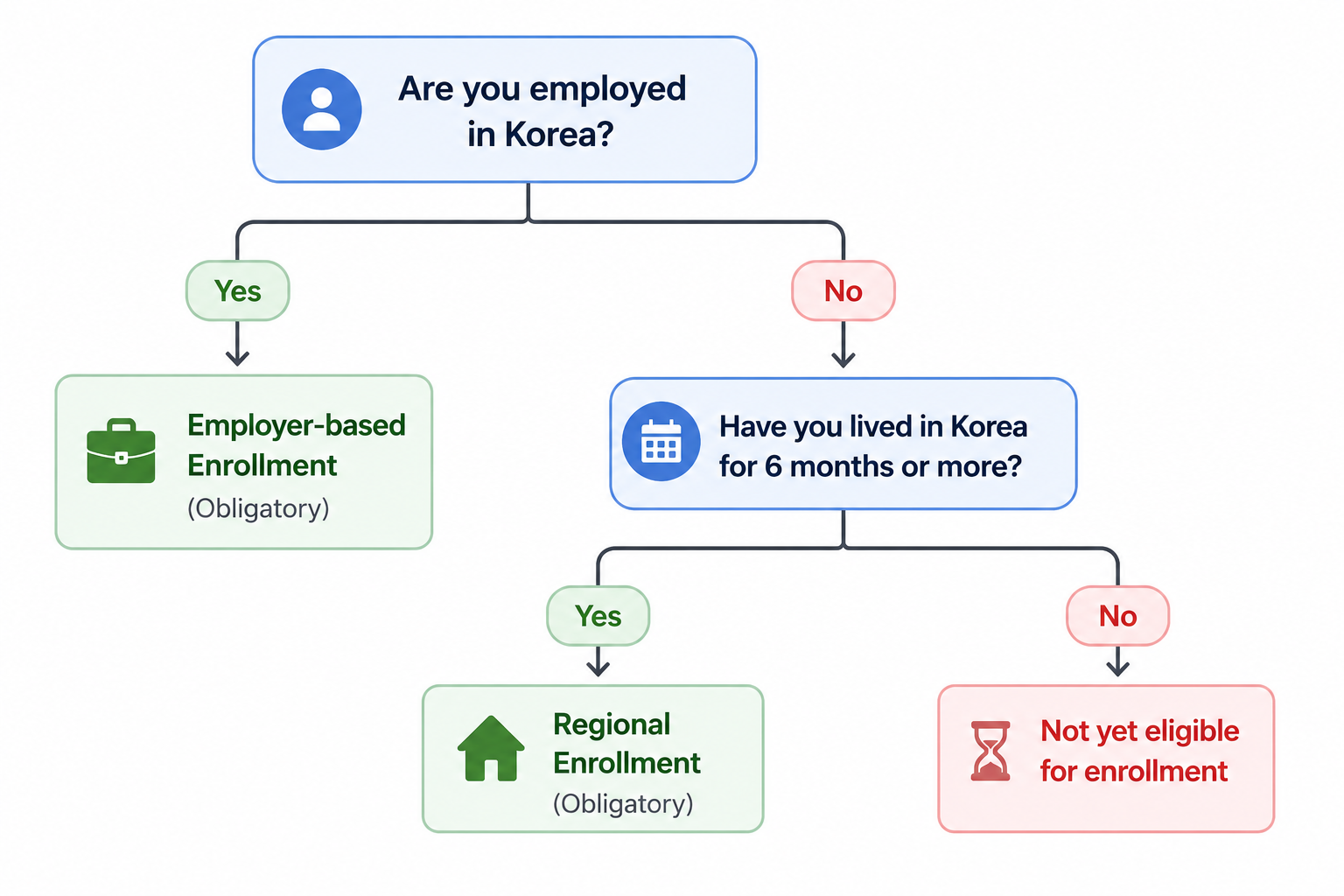
Korea's National Health Insurance is mandatory, and it covers residents regardless of nationality. There are two ways you end up in the system:
- Employer-based (직장가입자): If you're employed, your workplace enrolls you—regardless of how long you've been in Korea. Your employer reports you within about 14 days of hire, and the premium is split roughly half-and-half between you and the employer.
- Individual/regional (지역가입자): If you're not employed through a Korean workplace, you're generally auto-enrolled as an individual subscriber once you've lived in Korea for 6 months.
💡 Students (D-2) and language-program students (D-4) fall under the individual/regional track and are auto-enrolled from their foreign resident registration—but with a significant discount (see below).
Who is not required to enroll
Short-term and certain statuses are outside the system: diplomatic (A), tourist/short-term (B, C), and some G-1 statuses are not enrollment targets. If you're on a short stay of under 6 months without a qualifying visa, mandatory enrollment generally doesn't apply—but note that switching to a long-term work visa (E-series, etc.) can make you eligible immediately.
What it costs in 2026
Premiums work differently depending on which track you're on.
Employer-based (직장가입자)
The premium is a percentage of your salary, split with your employer. For 2026, the standard NHI rate is set at 7.19% of your monthly salary, split 50/50 with your employer (~3.595% from your paycheck). Note that Long-Term Care Insurance (노인장기요양보험) is automatically included with NHI, bringing your actual payroll deduction to around 4.05% of your salary.
💡 Tip for Foreign Workers: While NHI is mandatory, foreign employees can choose to opt out of the Long-Term Care Insurance portion by submitting an exemption application (장기요양보험 가입제외 신청) through their employer to the NHIS.
The higher your salary, the higher the premium—it scales with income.
Individual/regional (지역가입자)
This is where many foreign residents land, and the rule is specific: because a foreign resident's Korean income and assets can be hard to assess, the system applies a minimum premium pegged to the average premium across all subscribers.
For 2026, that minimum works out to roughly ₩158,630 per month for foreign individual subscribers. Your actual bill can be higher if your assessed income, property, or vehicle pushes it up—but it generally won't fall below that floor.
💡 Because the exact figure changes each year (rates are re-set every November for the following period), always confirm your specific premium at nhis.or.kr or by calling 1577-1000.
The student discount
This is a big one for the international students this platform serves: D-2 and D-4 students—and F-4 overseas-Korean students—qualify for a roughly 50% reduction on their health insurance premium. That brings a monthly bill down substantially from the standard individual-subscriber floor.
| Your situation | Track | Rough 2026 monthly premium |
|---|---|---|
| Employed in Korea | Employer-based | ~half of a salary-based percentage (varies with pay) |
| Not employed, 6+ months in Korea | Individual/regional | From ~₩158,630 |
| D-2 / D-4 / F-4 student | Individual/regional | ~50% of the above |
⚠️ These are reference figures for planning. Your official amount comes from the NHIS, not from this table—check it once you're enrolled.
What insurance actually covers
National Health Insurance covers a large share of most medical costs—commonly in the range of 60–80% of covered treatment, with you paying the remainder out of pocket. That's the difference between a routine clinic visit costing a few thousand won versus tens of thousands.
What it typically does not fully cover:
- Most dental work
- Vision correction (glasses, LASIK)
- Elective MRI and some scans
- Various "non-covered" (비급여) procedures
Many residents fill these gaps with private supplementary insurance (실손보험), but for everyday illness, injury, and hospitalization, NHI does the heavy lifting.
How to enroll and handle the paperwork
If you're employed: you generally don't do anything—your employer files the enrollment. Just confirm it happened, since a missed filing can create back-premiums and penalties for both sides.
If you're an individual/regional subscriber: enrollment is often automatic at the 6-month mark, but you may need to visit or contact the NHIS to sort out your details. Bring your ARC and any income documentation (or a no-income declaration). You can also handle enrollment and questions through the NHIS website or app.
⚠️ Health insurance status can affect your visa extension and change review. Unpaid premiums or a lapsed status can come back to bite you at immigration—so don't ignore the bills.
A few situations worth knowing
- Dependents (피부양자): An employed subscriber's spouse and children can often be registered as dependents without a separate premium, if they meet income/asset requirements. Under Korean regulations, most foreign dependents (such as parents or adult children) must reside in Korea for at least 6 months before they can be registered under an employed subscriber. However, an employed subscriber's spouse and minor children (under 19) are exempt from this 6-month residence requirement and can be registered immediately upon entry.
- Social security agreements: Some countries (e.g., the US, Germany) have agreements with Korea; with proof of home-country coverage, an exemption may be possible. Check with the NHIS whether your country qualifies.
- Already paid premiums aren't refundable, so enrolling and paying is the practical path, not something to try to opt out of after the fact.
Quick reference
| Question | Answer |
|---|---|
| Do I have to enroll? | Yes, if employed, or after 6 months' residence on a qualifying visa |
| When does it start? | Employed: from hire. Individual: after 6 months (students: from ARC registration) |
| 2026 individual minimum | ~₩158,630/month |
| Student discount (D-2/D-4/F-4) | ~50% off ⚠️ Student Warning: Your ~50% discount applies as long as your student visa and enrollment status remain active. If you take a leave of absence (휴학), change your visa type, or leave Korea for an extended period, your discount may be automatically revoked, or you may be re-classified as a standard regional subscriber. Always double-check your status with the NHIS if your school enrollment changes. |
| What's covered | ~60–80% of covered care; dental/vision/elective often excluded |
| Where to confirm your amount | nhis.or.kr or 1577-1000 |
Settling in and juggling health insurance, banking, and address registration all at once? Membership includes post-move-in settlement support—we help you get the essentials sorted so nothing slips through the cracks in your first months. Get Daily Assistance during your life in Korea →